Reading the Shape of a Sentence: The Paintings of Marion Piper
What if a painting could be read like a sentence? In the work of Marion Piper, lines pause like commas, colours introduce emphasis, and shapes unfold with the cadence of language. These restrained abstract compositions reveal a quiet but powerful relationship between painting and literature, where titles, rhythm and form operate together as a kind of visual syntax.
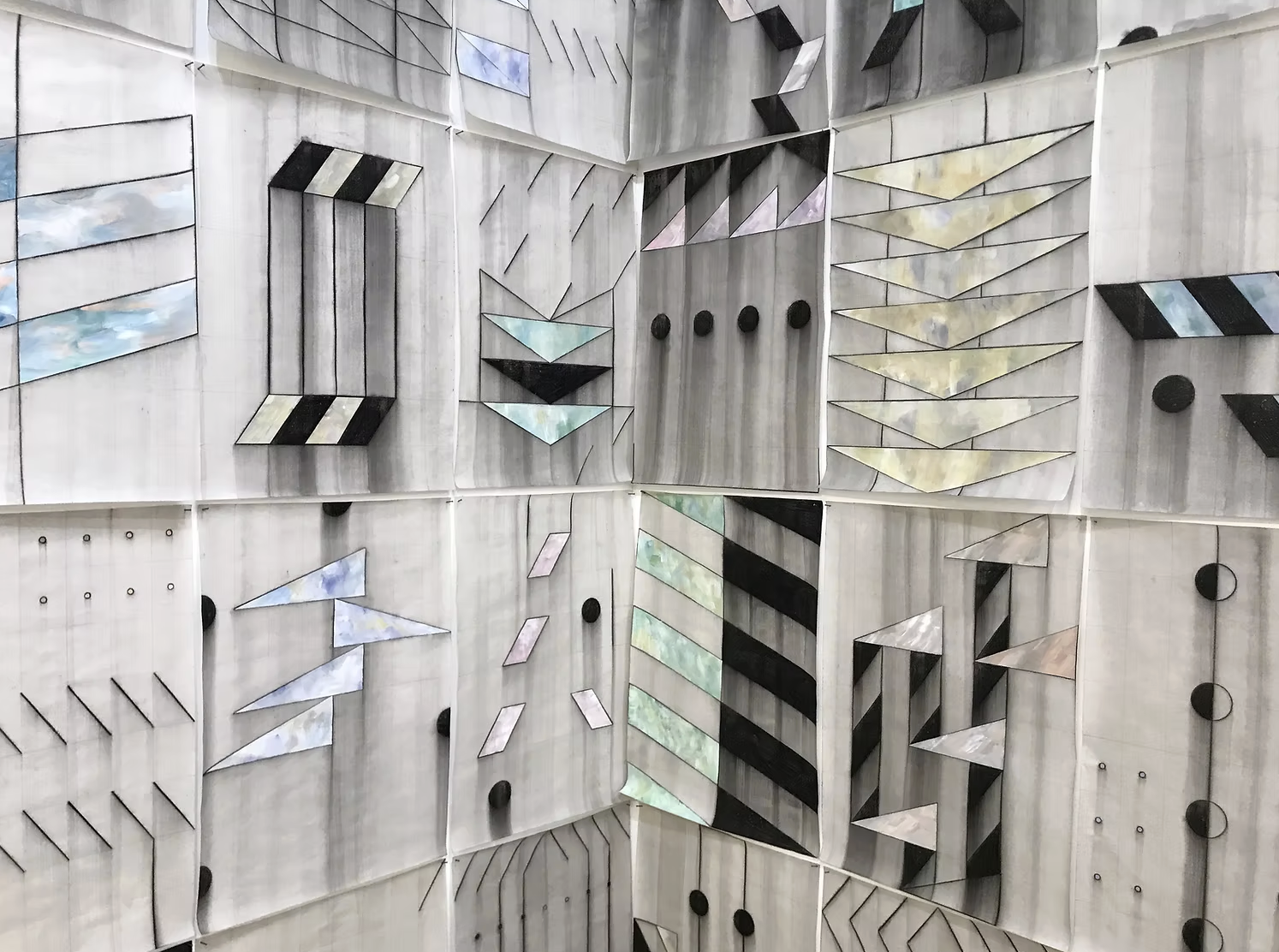
There is something quietly literary about the paintings of Marion Piper. Not literary in the obvious sense of illustration or narrative depiction, but in the way a sentence moves across a page, or how a pause interrupts the breath of a line of poetry. Piper’s works do not tell stories. Instead, they operate more like fragments of language, small grammatical units through which meaning gathers gradually. A mark behaves like a comma, a coloured arc becomes a kind of emphasis, a repeated line insists like a refrain. The paintings begin to read like sentences whose syntax has been displaced from words to form.
Titles play a crucial role in this process. Piper’s works often carry titles that feel oddly specific and strangely open at the same time: The Reminder, Where they Lived, and auspiciously, READER. These titles do not describe the image so much as they hover beside it, offering an entry point into a conceptual atmosphere. Piper has described how words often arrive during the act of painting itself, appearing in the space between artist and surface as though the work were generating its own language (Piper, n.d.). The title becomes less a caption than a residue of thinking, a trace of the internal dialogue that accompanies the act of making.

Looking closely at Piper’s paintings, one begins to sense that they are constructed through a logic closer to punctuation than composition. Lines and arcs appear with a spareness that feels deliberate, as if each element must justify its presence. A curve interrupts a field like a clause inserted into a sentence. A vertical line stabilises the structure like the spine of grammar. There is often a sense of rhythm at play, a pacing between elements that resembles the movement of reading. One shape leads to another, pauses occur, emphasis is placed, and then the surface resolves into a balanced statement.
The relationship between visual form and language has long fascinated artists working within abstraction. Wassily Kandinsky famously proposed relationships between colour, sound, and internal resonance within abstract painting (Kandinsky, 1912). Paul Klee similarly described drawing as “taking a line for a walk,” suggesting that the line itself carries an exploratory and narrative capacity across the surface (Klee, 1961). Yet Piper’s work sits closer to a linguistic model than a musical one. Her compositions feel less like melody and more like syntax. They organise space in ways that resemble sentences, where meaning emerges through relationships rather than representation.
This linguistic quality may partly derive from Piper’s sustained engagement with the intersections of art history, design and literature. Her project The Drift explicitly explores the relationships between cultural texts and visual structures, positioning painting as a site where references circulate and recombine across disciplines (Piper, n.d.). The work carries the residue of reading, of thinking through other forms of cultural language. Titles sometimes reference places, infrastructures, or mechanical systems, forming a vocabulary that echoes through the body of work. The painting becomes a place where these fragments of language quietly accumulate.

Piper has also written about colour operating almost like tone within a composition, suggesting that colour relationships can introduce a form of visual dissonance comparable to the opening sentence of a novel that establishes rhythm and expectation (Piper, 2019). The analogy is revealing. It implies that a painting might unfold structurally in the same way a piece of writing does. In Piper’s case, this opening gesture often appears through a carefully positioned line or colour field that establishes the internal grammar of the image.
Such structural thinking also aligns Piper’s practice with longer histories of modern abstraction. Josef Albers, for example, approached painting as a system of relational perception in which colour behaves contextually rather than symbolically (Albers, 1963). Yet Piper’s work never feels doctrinaire or rigidly formalist. The shapes remain light, provisional and conversational. They test possibilities rather than declare conclusions.
It would be easy to read these paintings as diagrams or design exercises, particularly given Piper’s background in textile and design training. But this interpretation risks overlooking the poetic dimension that runs quietly through the work. The forms are not instructions. They are propositions. Each painting proposes a relationship between elements and allows the viewer to dwell within that relationship. The painting becomes a site of visual thinking.
Here Piper’s work begins to resemble literature most closely. A poem rarely explains itself directly. Instead it offers a constellation of words whose arrangement produces meaning through rhythm, spacing and association. Piper’s paintings operate in a comparable way. Their shapes are sparse yet loaded with implication. A curved segment suggests motion. A straight line introduces order. A coloured wedge implies direction. Together these elements form a visual syntax that the viewer gradually learns to read.
Michel Foucault once suggested that modern painting reveals the underlying structure of the canvas itself, exposing the geometry that representation often conceals (Foucault, 1999). Piper’s paintings continue this legacy by foregrounding the structural logic of the surface while allowing gestures to move across it with quiet independence. The canvas becomes both page and field, structure and improvisation.
What makes Piper’s work particularly compelling within contemporary abstraction is its refusal to overwhelm the viewer with complexity. The paintings operate through restraint. Their language is concise, almost aphoristic. Each element carries weight precisely because there are so few of them. In an art world often driven by spectacle, Piper’s paintings behave more like carefully constructed sentences than declarations. They reward slow reading.

To stand before one of Piper’s paintings is therefore not unlike encountering a short piece of writing whose meaning unfolds through rhythm and emphasis. The viewer scans the surface, pauses, returns to a line, notices the balance between shapes. Gradually the painting resolves itself not as an image to decode but as a structure to inhabit.
In this sense Marion Piper’s paintings might best be understood not simply as abstractions but as acts of visual writing. They occupy a threshold between language and image where marks function as punctuation, colour becomes tone, and composition develops the cadence of a sentence. The viewer does not merely look at the work. They read it.
This essay forms part of the inaugural Virga Essay Series, a sequence of three Critical Wednesday texts by Dr Gemma Marmalade and Dr Jane Boyer spotlighting the represented artists of Virga Gallery and its imprint Virga Press: Linda Alterwitz, Marion Piper, and Juan Sebastian. The series precedes the official launch of Virga Gallery and Press. For announcements, launch details, and forthcoming events, please follow Instagram @virgagalleryandpress
References
Albers, J. (1963) Interaction of Color. New Haven: Yale University Press.
Foucault, M. (1999) Manet and the Object of Painting. London: Tate Publishing.
Kandinsky, W. (1912) Concerning the Spiritual in Art. Munich: Piper Verlag.
Klee, P. (1961) The Thinking Eye. London: Lund Humphries.
Piper, M. (2019) READER: Artist Talk Notes. Oxford: Magdalen Art Space.
Piper, M. (n.d.) ‘Studio reflections and project descriptions’. Available at: https://www.marionpiper.com (Accessed: 1 March 2026).
Link to Marion Piper: https://www.marionpiper.com
