A review of the Online Objectification Project led by Leeds Arts University
There is something unsettling about the language of resilience when we talk about girls online.
Resilience is, ordinarily, a virtue. We want young people to possess confidence, critical judgement and the ability to recover when the world is unkind. Yet, when resilience becomes our principal response to an environment that repeatedly harms them, the word begins to carry a different weight. At what point does teaching someone to withstand something become an acceptance that the thing itself will continue?
This question sits beneath the Online Objectification Project, led by Dr Dawn Woolley at Leeds Arts University in collaboration with Getaway Girls and an interdisciplinary academic team. The research examined how girls and young women experience objectification on social media, bringing their voices into the research through interviews, creative workshops and the co-creation of an animated intervention designed to encourage reporting and peer support.
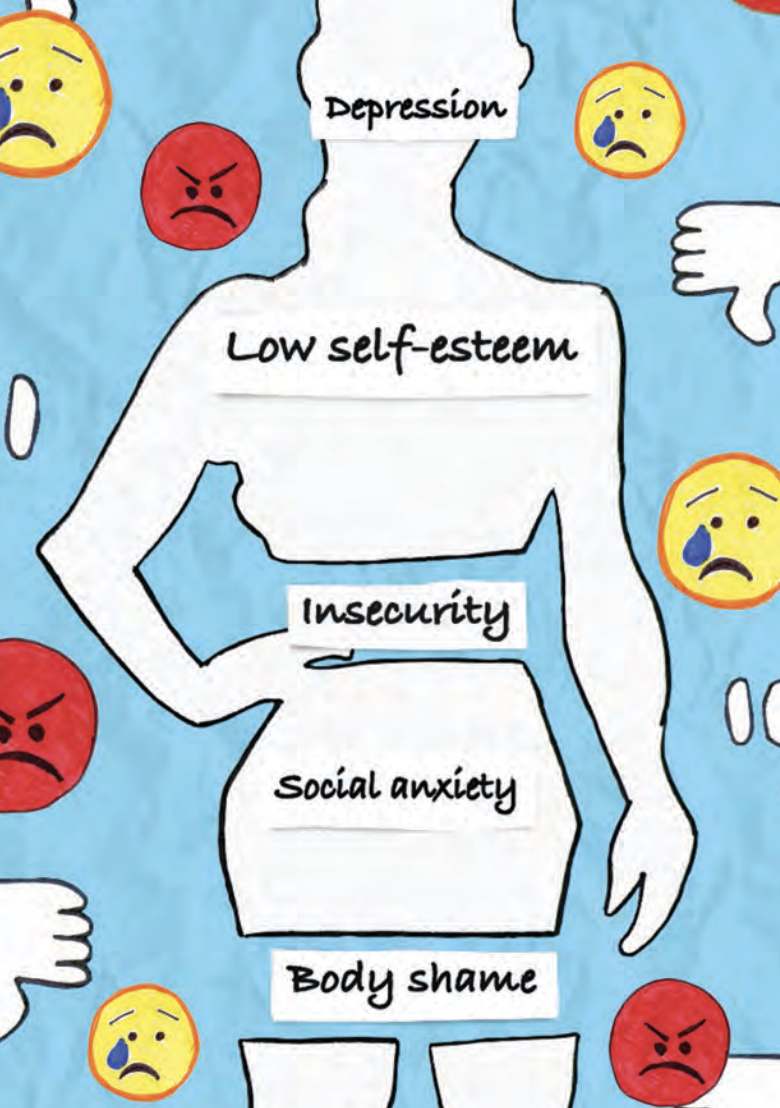
Its findings are difficult, although perhaps no longer surprising. Participants described body shaming, sexualisation, misogyny, unwanted attention and gender stereotyping. More strikingly, they described a persistent feeling of being watched and judged, sometimes by strangers, but also by friends and family.


This is not simply a problem of unpleasant comments. Surveillance changes behaviour, as illustrated by these conversation prompt postcards.
Girls described limiting their self-expression, making accounts private, leaving group chats, scrolling past content and attempting to make themselves less available to unwanted scrutiny. Others challenged what they encountered, although some questioned whether doing so made any material difference. The emotional consequences ranged from anger and embarrassment to shame, fear and distress, with participants describing longer-term consequences for mental health and their willingness to present themselves freely online.
Perhaps the most disturbing finding is therefore not that misogyny exists online. We know this. It is how ordinary its presence has become.
When hostility is sufficiently commonplace, adaptation can begin to resemble acceptance. A girl learns what not to post, which comments not to read, whose attention to anticipate and when speaking back is likely to make matters worse. Eventually, navigating misogyny becomes another form of digital literacy.
That should trouble us.
The project offers a hopeful counterpoint. Working with girls rather than simply conducting research about them, the team used creative practice to transform experience into language, imagery and collective action. The resulting animation encourages young women to establish boundaries, support one another, restrict unwanted access and, memorably, to “block, report, support”. The subsequent study of 285 young women aged 16 to 18 found that attitudes towards reporting objectifying material became more positive after viewing the intervention.
This matters. So does the project’s emphasis on co-creation. Too much institutional work concerning young people asks them to provide testimony while adults retain authority over what that testimony ultimately becomes. Here, creative participation was treated as a form of knowledge. The girls were not merely evidence of a problem. They contributed to imagining a response.
But we should take that response further.
There is a danger in locating the solution to harmful environments primarily within the resilience of those experiencing them. If a woman modifies what she wears, where she goes and how she behaves because a physical space feels unsafe, we increasingly understand that the problem is not simply her capacity to navigate danger. The same principle must apply online.
A better question is not only, “How can girls become more resilient online?” It is, “Why are digital environments still being constructed in ways that require this degree of resilience from them?”
The distinction matters because social media is not a naturally occurring landscape. Platforms are designed. Recommendation systems decide what travels. Interfaces determine how easily people can report abuse. Moderation policies determine what remains visible. Engagement systems can reward outrage, conflict and attention regardless of whether that attention is healthy. These are choices, even when they are disguised by the apparent neutrality of technology.
There has been movement. Under the Online Safety Act, technology companies operating in the UK now carry greater responsibility for illegal and harmful content, while Ofcom’s guidance on protecting women and girls explicitly calls for safety to be considered in the design of online services. The regulator has proposed measures ranging from better reporting systems and controls against coordinated harassment to interventions that disrupt misogynistic content and toxic recommendation loops.
This becomes still more urgent as artificial intelligence alters what it means to be visible online. Misogyny no longer requires access to a woman’s body, or even to a real photograph of that body, in order to sexualise it. Synthetic intimate imagery has extended the possibilities for objectification beyond representation into fabrication. Ofcom reports that 99 per cent of deepfake intimate image abuse depicts women. UK law has consequently begun criminalising the creation of non-consensual purported intimate images and the provision of so-called nudification tools.
The technology changes. The underlying question of power does not.
Who gets to look? Who is looked at? Who controls the image? Who profits from its circulation? Who is expected to change their behaviour when something goes wrong?
One of the strengths of the Online Objectification Project is that it allows girls to answer these questions from inside their own experience. Its participants also make clear that responsibility cannot stop with them. They call for better platform controls, meaningful action when harmful material is reported, education within schools, spaces for peer support and, crucially, interventions directed towards boys and young men.
Perhaps this is where the conversation needs to go next.
We should absolutely equip girls to recognise objectification, challenge it where they choose, support one another and understand that what they encounter online is neither inevitable nor deserved. But resilience should be a resource available to them, not an entrance requirement for participating in public life.
The ambition cannot simply be to raise girls strong enough to survive harmful digital spaces.
It must also be to build digital spaces that no longer ask so much of them.
Credits:
Dr Dawn Woolley – Researcher and Visual Artist, Leeds Arts University
Professor Sally Dibb – Marketing & Society, Manchester Metropolitan University
Magdalena Zawisza – Associate Professor in Consumer & Gender Psychology, Anglia Ruskin University
Dr Katie Thompson – Lecturer, Manchester Metropolitan University
Margot Q. Lefevre – Research Assistant, Anglia Ruskin University
Flavia Docherty – CEO, Getaway Girls
