Zhejun Gao, Beichen Zhang, and Dr Megan Carnrite explore the transient meanings of cultural objects as they circulate through social systems in New Exorcist.

Dr Megan Carnright, who discussed her camera-less, haptic approach to photography for the [c] Word at [c]CC Art School last year, was invited by curator Zhejun Gao to participate in the opening conversation of Beichen Zhang: New Exorcist at Asymmetry in London on 25 April. Carnrite’s contribution to the exhibition discourse touched on some of her interests in photographic materials/technologies, and the visual disruptions possible in unconventional approaches. For example, the application of her mouth as an active image-making tool resulting in visualisations of the mouth that are indexical rather than iconic and function outside the usual representations of the body.

Gao’s interest in Carnrite’s research lays in her use of the body in direct contact with photographic materials to capture trace impressions of the body, rather than to image the body through a lens. They met at conference where Carnright gave a paper on X-ray in relation to death for an archaeological context instead of medical diagnosis. Gao, who is Asymmetry Curatorial Research Fellow at Chisenhale Gallery, continues his own research into how the mediation of cultural objects changes meanings, through the New Exorcist project. In a nuanced curatorial strategy, Gao aligns Carnrite’s sustained interest in photographic technologies for visualising what can’t be seen, transforming the familiar into the unfamiliar, with Beichen Zhang’s extensive investigation into the displacement and transformation of cultural objects.

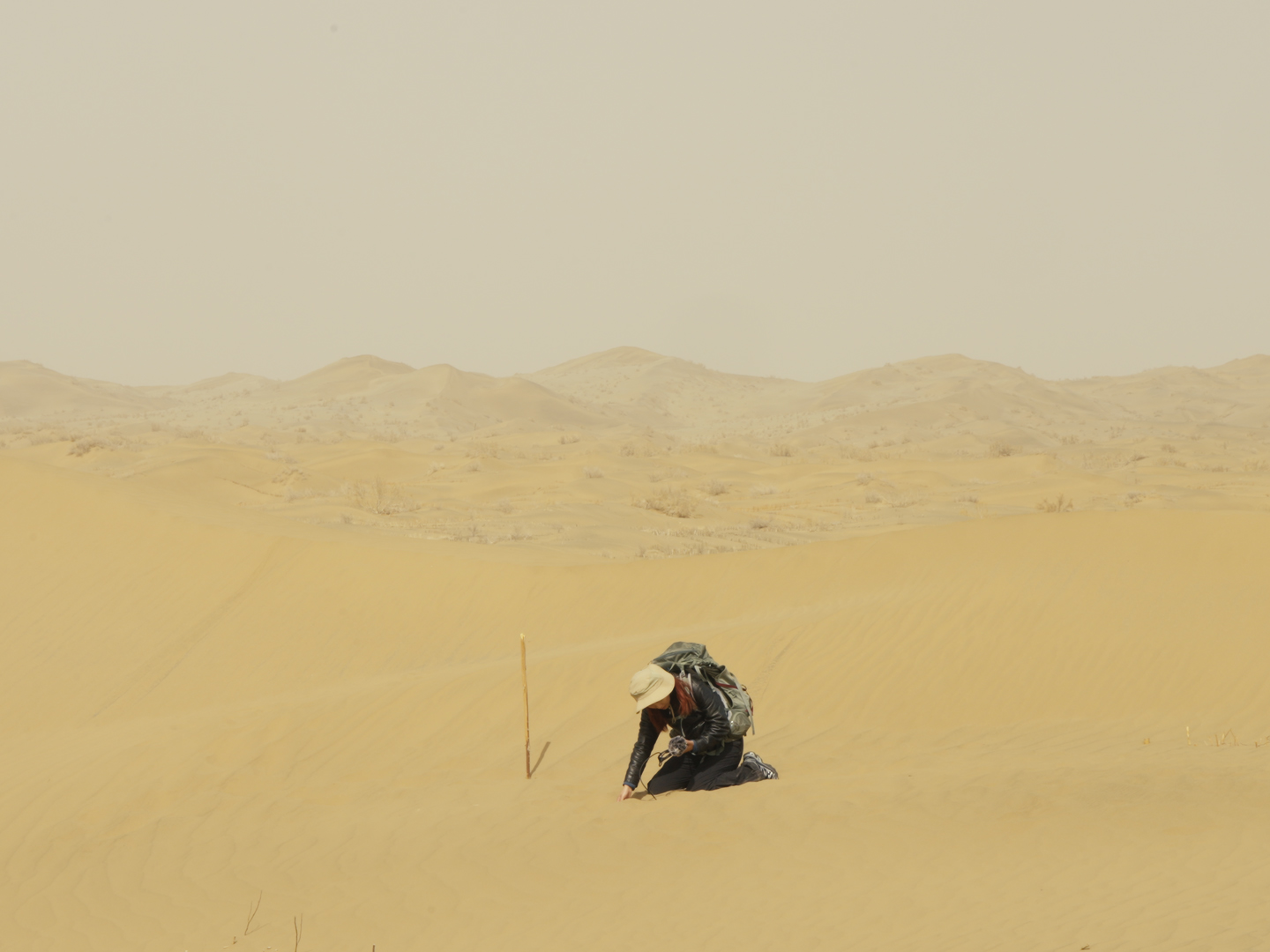
With New Exorcist, a double-channel video piece, Zhang re-visions Pazuzu, a formless wind demon from ancient Mesopotamian mythology associated with the duality of destruction and protection. Pazuzu is not a stable cultural object in Zhang’s hands. He is a mutable figure shaped by cultural circulation, interpretation and appropriation. Through New Exorcist, Zhang transforms the notion of exorcism into an institutional operation where formless anomalies and incongruities are rendered legible, but which also risk a failure to be contained. Using keyframes from William Friedkin’s The Exorcist (1973) film in conjunction with an erratic Pazuzu force disrupting a speculative landscape, Zhang draws attention to the instability of boundaries and meaning.

Carnrite’s contributions to the project discourse echoes these concerns. She says:
“I wanted to engage with Beichen’s work and New Exorcist because of my interest and work around the boundaries of the body, and our innate drive to understand and experience ourselves as bound, contained forms. In my own work, I push against this drive by purposefully breaking through those boundaries and argued that one of the reasons we find The Exorcist so horrifying is that Regan’s body becomes penetrated by an unknown, uncontainable force, exposing the vulnerability of the body and disrupting that sense of containment.”
Displacement. Boundaries. Transformation. We live in a world where containment is no longer a manageable operation. Meaning shifts, labels erase through oversimplification, and circulation is a reductive force. Through New Exorcist, Zhang, Gao, and Carnrite demonstrate the pressure points where certainty is upended, containment becomes the threshold of transformation, and boundaries are no longer readable.
Find out more about the exhibition programme and installation Beichen Zhang: New Exorcist at Asymmetry. The exhibition runs through 21 May but check with the gallery for programmed screenings of the film, New Exorcist.
Beichen Zhang: New Exorcist
25 April – 21 May 2026
Asymmetry HQ, 102a Albion Drive, London E8 4LY
Opening hours: Tuesdays to Thursdays, 2–6 pm
Additional screening: 09 May, 2 – 4:30 pm
