A new project in collaboration with Leamington Spa Art Gallery & Museum exploring objects inherited after death and the emotional weight those objects carry.

For the past eight months, Claire Morris-Wright has been working in consultation with the curator of history, Abigael Flack, at Leamington Spa Art Gallery & Museum, along with Ali Cox, who previously worked in Education at Tate Modern and Compton Verney, and now is a death doula. Leamington Spa Art Gallery & Museum was making plans for an exhibition of Victoria memento mori when Claire approached them with an idea to do a residency working with objects in the museum stores. She wanted to look inside a museum where the collections are eclectic; a museum where she could make her own memories connect to someone else’s in the area where she grew up and maybe discover links with the objects in the collection and those in her family.
Claire’s interest in this subject came about after the successive deaths and subsequent clearance of two parents’ houses with a multitude of objects. This experience made Claire wonder at the objects we inherit. Not just the property, objects, or ephemeral photographs, letters, and notes left behind, but the emotional weight of these things. Where does a lifetime of consuming end up? Why do one person’s possessions have more weight and importance than another’s? Why are some objects deemed important enough for a museum? Is it the value or the usefulness of the objects, the social standing of the individual, or do they genuinely act as vessels containing memories that reverberate with the presence of a deceased person, their relationships, the time of living, or their lived experience? These are some of the questions Claire is researching through the project.
Some objects deposited or bequeathed to the museum that Claire has chosen to work with have a connection to her personal story. These items have an uncanny resonance without any known link to her own family. This resonance caused a strange visceral reaction within Claire when seeing them for the first time, and this has become her measuring stick for selection and inclusion for the upcoming exhibition.
These are the same kinds of experiences and questions that Walter Benjamin was having when he was walking the shopping arcades of Paris in the 1920s. The question, which became the basis for his unfinished Arcades Project, was “how ‘concrete’ one can be in connection with the history of philosophy.”[1] In other words, how can objects translate as provocations to history? The outdated objects in these covered commercial walkways still reverberating with the nineteenth century industrial revolution and mass culture “were to provide a Marxist-revolutionary, political education for Benjamin’s own generation of historical subjects,”[2] and which have become some of the most profound observations about subjectivity, history, memory, and objects informing our contemporary arts culture.
We, as a society, are at a similar juncture as Benjamin was in the Arcades with the development of AI and all the challenges it poses to our social structures. Our modernist, postmodernist, and quantum posthuman age sit side by side everywhere in our Western culture. In politics, we see trusted institutions coming under attack by idealogues, and sovereignties of all kinds being destabilised while we continue to live with Cold War threats of nuclear annihilation. At the heart of all these shifting forces is the visual communication of images and the residue of histories imbued in objects.
As Susan Buck-Morss, whose book, The Dialectics of Seeing, explains, Benjamin’s Arcades Project “develops a highly original philosophical method, one which might best be described as a dialectics of seeing.”[3] Buck-Morss explains that Benjamin’s method relied not on reading history to develop his theories, but on an altogether different approach. He used the interpretive power of images to find those pressure points of communication to comment on the world around him. Buck-Morss says Benjamin’s method “is grounded…on philosophical intuitions sparked by cognitive experiences reaching as far back as childhood,”[4] the same way Claire is working in her project. In time, Benjamin would call the results of this method the dialogical image.
In my own 2018-19 residency working with the collections in the Fitzwilliam Museum, Benjamin’s notion of dialectical seeing and the dialectical image informed the intuitive process I used of selecting objects that attracted my attention for the purposes of making new work. Explaining this process at the time, I wrote:
Dialectical seeing is a process of intuition and imagination, which makes meaning from encounters with historical objects. This process results in the dialectical image; an image that is fleeting and breaks free from a former context to enter a different sphere of meaning. That is, for objects to be taken out of the continuum of the past and made ‘“actual’ in the present” involves the mediation of a viewer’s imagination and “the active intervention of the thinking subject.”[5]
We could say then, we see with our memory, and the collision between a remembered past, an immediate moment, and an anticipated future often tempered by anxiety, helps us move forward into unknown territory.
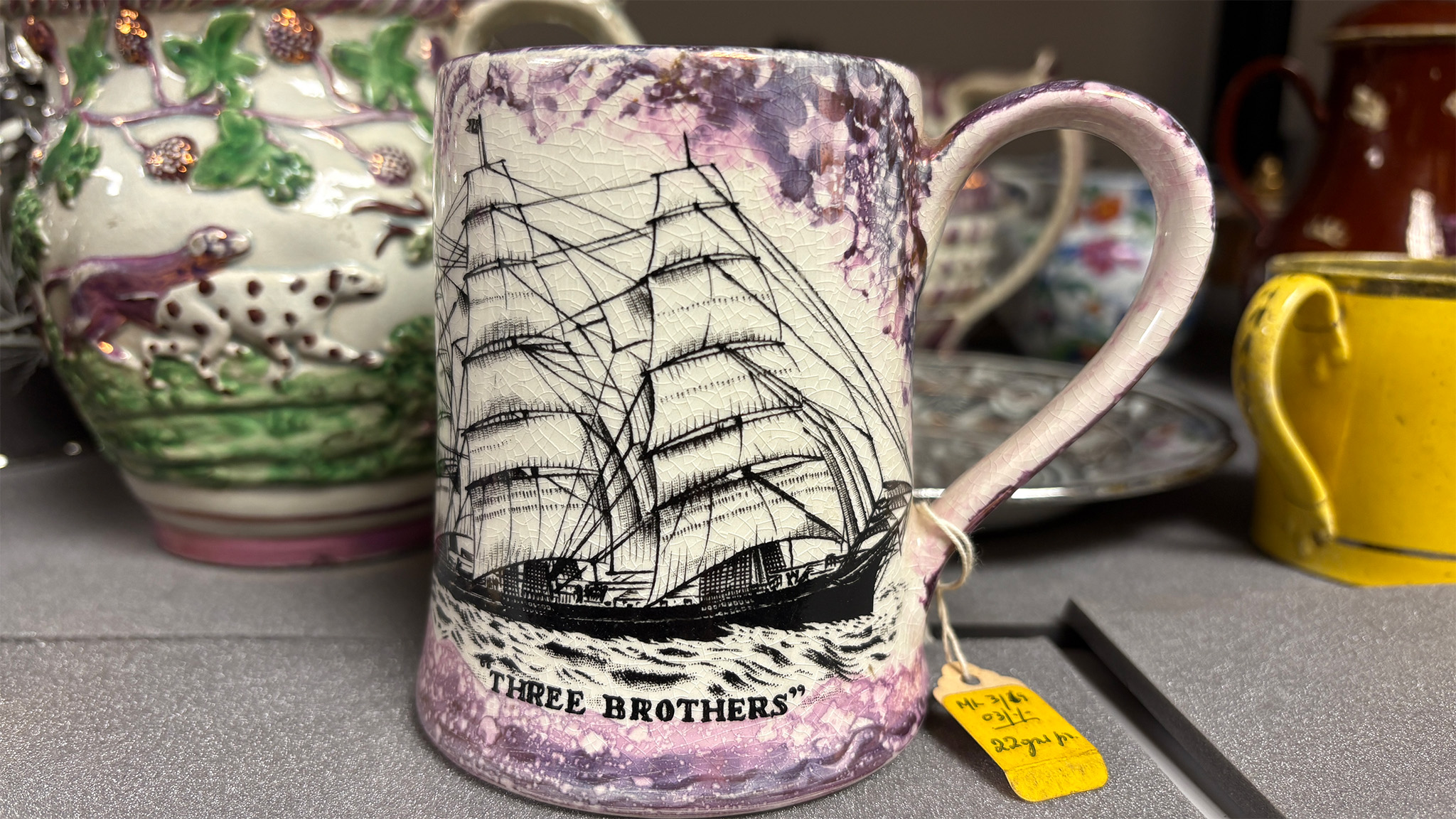
Claire’s intention through her project is to make personal statements in the form of artworks using some of the items she has chosen as a creative springboard, for example a stitched sampler with altered words, mugs with brotherly references, and a book made from handmade papers. All these artworks are currently in process and have come about while listening to her intuitive response to objects found on shelves and within the vaults of a museum in the town where Claire grew up. For the final exhibition, the artworks will be displayed alongside the items with text explaining Claire’s own reference points and responses.
Claire says, “art can enable resolution and wounds to heal, and this project has been a deep investigation into what happens to us when all the ‘stuff’ we inherit is distributed,” and she asks, “what do we do with our emotional baggage, the aftermath, the relief or grief?” Intuition is the engine of explorations like Claire’s, and like Benjamin’s dialectical image, the point of contact between the past and the present can result in a meaningful interpretation of a dusty history that speaks to our future. AI will never do that for us. No technology has all the answers. Nor does it always provide a satisfying transition into a new paradigm. We need the past. We need to connect with and fantasise about objects. We need to allow our intuition to lead us on paths of imagination that may otherwise be obscured.
Claire Morris-Wright was a guest speaker during our [c]CC Art Summer School of 2025. She spoke about her Hedge Project and The Path, both funded by Arts Council England. Claire new project with Leamington Spa Art Gallery & Museum is Objects of Death: Memento Mori, which is scheduled to be on view from October 2027 to January 2028.
[1] Buck-Morss, S., 1989. The dialectics of seeing: Walter Benjamin and the Arcades Project. Cambridge, MA: MIT Press. Quote on page 4.
[2] Ibid, pp. 4-5.
[3] Ibid, p. 6.
[4] Ibid, p. 7.
[5] Boyer, J., 2020. The expanded mirror. PhD thesis. Anglia Ruskin University. Available at: https://hdl.handle.net/10779/aru.23767011. Citing Buck-Morss from The Dialectics of Seeing, pp. 221-222.
