Curated by artist, Julie Hoyle, Occupied: Strange Company brings together 23 contemporary artists whose works temporarily inhabit the rooms of the Safehouses in Peckham. Set within the remnants of domesticity, painting, sculpture, print, installation and moving image sit alongside one another in unexpected ways, shifting the atmosphere of the house and rendering the familiar strange.

This contemporary temporary exhibition curated by Julie Hoyle inhabits Safehouse 1 & 2 in Peckham for only three days, from 15 to 17 May. But these are three days not to be missed. Hoyle brings together 23 artists who are deeply engaged with the implication of the body in time, space, and environment. Not that these artists are depicting the body in their art or even representing the body as a political space or force, but many imply the body in occupation of thought, remembering, and tracing evidence of the body’s presence. In other words, these artists are rendering the invisible activities a body does that leave physical traces of its existence. Situating this exhibition within two derelict Victorian houses is a meaningful act that raises the venue from a ‘container’ to an allegorical body occupied by the ghosts of habitation in dialogue with all the implied bodies in their occupations. Hoyle explains:
Stripped back and timeworn, the buildings retain traces of former lives, creating a setting that is both compelling and unsettled. Through proximity and placement, works that would not ordinarily be seen together form unexpected relationships across the space. Together, the exhibition forms a temporary community of presences…that create a charged and shifting environment in which the familiar is rendered persistently strange.
These are important impulses for contemporary art, which in Occupied: Strange Company raise a congruity with the writing of Stacy Alaimo, whose purpose in Bodily Natures is to realign our bodies with nature. “If nature is to matter, we need more potent, more complex understandings of materiality,” Alaimo claims.[1] She reimagines human corporality as trans-corporeality by which she means the substance of humans moves across bodies and is inseparable from the more-than-human existence of the environment. Hoyle suggests through the curation of Occupied: Strange Company, that this kind of entanglement also happens in our domesticity. The artists in this exhibition are working out what this looks like, not only in terms of the natural world, but also within the habitable environments we live in. Here are some examples:

Fungai Marima explores themes of womanhood, investigating through video, image projections and photography the liminal space between the undoing of oneself and the process of becoming Self. Las Animas (the souls) is a collage of fragmented body parts that come together to create a series titled ‘I don’t know why I do the things that I do’ questioning our beliefs, perception of self, and how much of an influence the world around us has on the decisions we make that ultimately make or break us.

Susan Aldworth’s work Reassembling the Self is a dysmorphia of the fragile, vulnerable body. In its interiority, the fragmented and reconfigured body, presented here through lithography, explores how identity may be disrupted through trauma, illness, or simply the experience of being alive. This is the body severed from, and struggling to re-entangle with the environment.

Mary Branson’s installation Slumber Lies explores the fragile boundary between rest and exposure through vessel forms and the sound of breathing, evoking a vulnerable presence within places we assume are safe. Slumber Lies explores the fragile boundary between rest and exposure. Situated within the intimate architecture of the bedroom, the work attends to the moment when vigilance falls away, and the body yields to its surroundings.

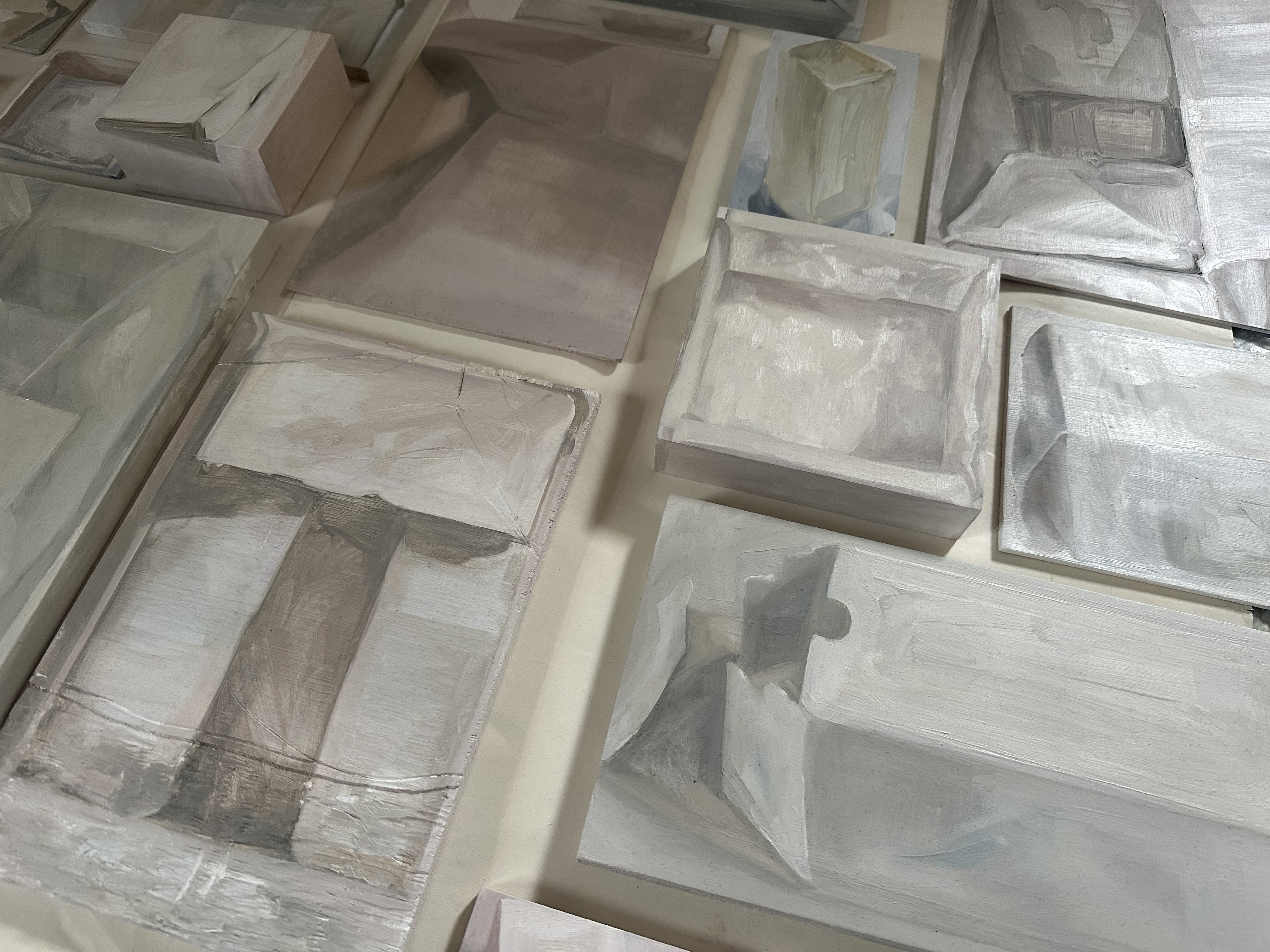
Sue Baker Kenton considers how things are kept, categorised and carried through time. Baker Kenton’s installation of painted, box-like structures reflects on containment and hidden histories. These are objects that crowd our lives and form bridges between the past and the present, reassuring us of our history as temporal beings. Baker Kenton implicates the body in these paintings. This is the body that accumulates mementos of cultural and personal talismanic significance, along with detritus and objects of profligacy. The body, once active in gathering, keeping, saving is remaindered here as sloughed husks, its past activity unknown. Nothing and everything of value is here.

Several works extend into speculative and cosmological realms. Susan Eyre’s video-sculptural installations, Guttanaut, imagine hybrid lifeforms at the intersection of the organic and inorganic, expanding the exhibition beyond the domestic into a wider consideration of time, scale, and the unknown.
Occupied: Strange Company is curated by Julie Hoyle.
Private View: Friday 15 May, 5–8pm
Exhibition Open: 15, 16 & 17 May, 11am–4pm
Safehouses 1 & 2, 139 Copeland Road, London SE15 3SN
Exhibiting artists: Susan Aldworth, Helen Baines, Sue Baker Kenton, Mary Branson, Emma Brown (with Freewheelers theatre and media company) , Janet Currier, Mandeep Dillon, David Ferry, Susan Eyre, Tessa Farmer, Adam Green, Penny Green, Oona Grimes RA , Julie Hoyle, Katherine Jones RA, Fungai Mirima, Karl Newman, Ann Norfield, Roya Pourzadi, Mirielle Schram, Tom Sliwinski, Marcelle Hanselaar, Temsuyanger Longkumer.
[1] Alaimo, S., 2010. Bodily natures: science, environment, and the material self. Bloomington, IN: Indiana University Press, p.2.

