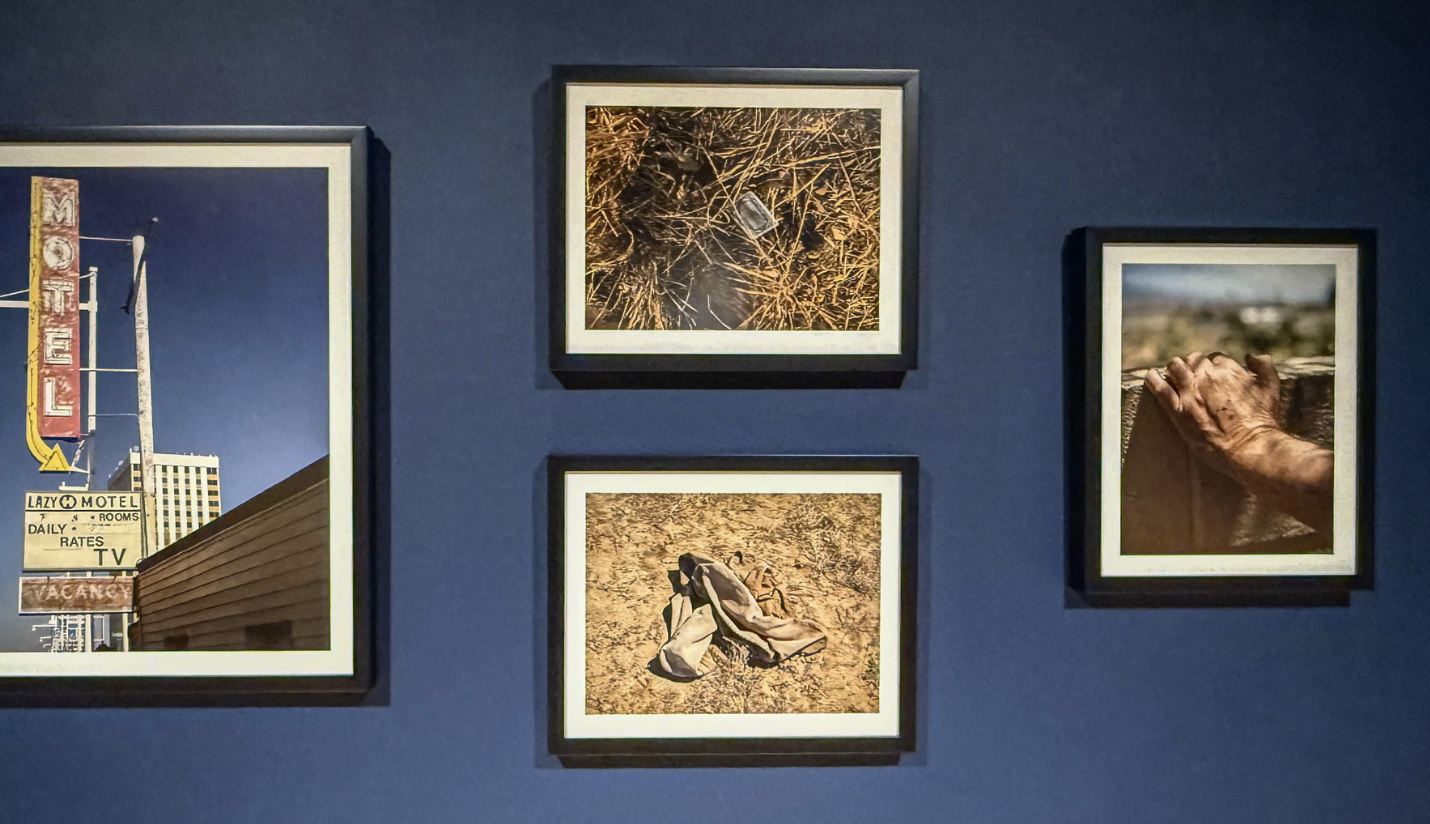
After touring the Summer 2025 exhibition of Claudio Nolasco at the Lowe Museum, University of Miami

To exist between places is to be continually reshaped by distance. Edward Relph once called this “placelessness,” not as simple absence, but as a rupture between rootedness and mobility, identity and perception (Relph, 1976). In the work of Claudio Nolasco, this rupture is rendered quietly luminous, textured with memory and estrangement, and composed through the visual idiom of post-documentary photography.
Born in Santo Domingo, Dominican Republic, and now living and working in South Miami, Florida, Nolasco’s biography is as integral to the reading of his images as the images themselves. Educated at Columbia (MFA, 2012) and Cooper Union (BFA, 2004), Nolasco’s fluency in the American documentary tradition is evident. This is not as mimicry, but as critique. His photography deconstructs the tropes of monolithic narrative and reassembles them into complex monographs and multi-image installations that interrogate belonging, citizenship, and selfhood in migration.
His recent exhibition at the Lowe Museum is less a display than a form of invocation. Here, the immigrant body—specifically, the Caribbean masculine body—is not shown as a site of trauma alone, but of contemplation. Of interiority. Of refusal to be simplified.
Under the Trump-era regime of ICE enforcement and the expanded surveillance of so-called “illegality,” the immigrant becomes a fugitive signifier. He is marked, hunted, and blurred. The post-documentary photographer, therefore, must work with paradox. As Allan Sekula argues, the documentary image has always risked instrumentalising suffering and transforming social conditions into objects of aesthetic contemplation (Sekula, 1984). And yet, it is precisely through this contested form that Nolasco finds an ethics of unspectacular visibility. These are images that breathe, pause, and doubt.
Nolasco finds an ethics of unspectacular visibility. These are images that breathe, pause, and doubt.
There is something neurodivergent in this approach. Not diagnostically, but metaphorically. Nolasco’s images process the world as a neurodivergent mind might: obliquely, refractively, and through atmospheres rather than declarations. The slowness of his gaze, the insistence on texture, on stillness, and on proximity without violation, creates space for those who are too often hurried out of the frame.
Neurodivergence, like migration, is a condition of difference and dislocation. The norms of perception, of behaviour, and of cultural legibility are constantly negotiated. In Nolasco’s visual vocabulary, this becomes a kind of philosophy: to be out of place is not to be without place. It is to inhabit the threshold.
In this way, Nolasco’s work resonates with Ariella Azoulay’s concept of the photograph as a civic encounter. It is not a static document, but an invitation to ethical spectatorship (Azoulay, 2008). His portraits and sequences do not tell a story. They withhold, gesture, and unfold slowly. Much like LaToya Ruby Frazier, Nolasco photographs not from above, but from within. The camera is not an instrument of mastery, but a medium of relation.

The American photographic canon, including Lange, Evans, and Frank, sought to reveal the nation to itself. But Nolasco’s post-documentary images refuse that act of revelation. Instead, they ask: What if the nation never looked in the first place? What if the archive is missing us on purpose?
To walk through Nolasco’s installation is to feel this question pulse. What does it mean to carry Dominican heat into a nation that chills the migrant soul? What does it mean to bear otherness not as a burden, but as a lens?
Place is not merely where we live. It is how we are allowed to be.
Azoulay, A. (2008). The Civil Contract of Photography. Zone Books.
Frazier, L. R. (2014). The Notion of Family. Aperture.
Relph, E. (1976). Place and Placelessness. Pion.
Rosler, M. (1981). In, Around, and Afterthoughts (on Documentary Photography). In 3 Works. Nova Scotia College of Art and Design.
Sekula, A. (1984). Photography Against the Grain: Essays and Photo Works 1973–1983. Nova Scotia College of Art and Design.
