In a world demanding sameness, artists must embrace difference — turning dormancy into the pause before eruption.
The creative climate of late 2025 is not simply one of fatigue or personal inertia. It is marked by the steady creep of right-wing social agendas across Europe, the United States, and beyond. These agendas promote conformity, punish dissent, and shrink the space in which free imagination can breathe. For many visual artists, this is the ground on which creative “ruts” form: a terrain where every experiment risks being surveilled, trivialised, or actively suppressed.
Yet when political conditions become hostile, the artist’s role becomes more urgent. Artists become the last bastion of intellectual and creative freedom. What looks like dormancy may in fact be hesitation under pressure, a pause before necessary rupture.
Difference, rights, and artistic rupture
Deleuze and Guattari insist that philosophy creates concepts rather than protects traditions (1994). To create is to resist. In a cultural field increasingly policed by suspicion of critical theory, artists who embrace difference directly confront the ideology of sameness that reactionary politics demands. From bans on queer literature to efforts to erase disability rights, the suppression of difference is explicit. Persisting in art that multiplies voices, bodies, and meanings is already an act of defiance.
Judith Butler’s notion of performativity shows that identities are never stable facts but processes of iteration (1990). For artists, this destabilisation is double: it allows practices to mutate beyond recognisable “styles,” and it refuses the political demand for fixed categories. Right-wing ideology thrives on clarity and enclosure: male/female, straight/gay, citizen/other, able/disabled. Art that unsettles these binaries—through fluid bodies, ambiguous forms, non-normative rhythms—enacts a refusal of containment.
Utopias in the shadow of regression
José Esteban Muñoz’s queer utopianism offers another vital resource. He argues that queerness is not simply what is, but what is not yet: a horizon that interrupts the present with the possibility of other futures (Muñoz, 2009). In a sociopolitical climate that insists “there is no alternative” to austerity, surveillance, and cultural retrenchment, the artist who dreams otherwise performs radical labour.
Deleuze reminds us that becoming is never linear, never moving toward a fixed identity. It is transformation, variation, experiment. The utopian impulse in art is less a blueprint and more an orientation: a way of keeping open the possibility of difference.
The body as counter-archive
Sara Ahmed has argued that institutional environments produce and enforce normative bodies, rewarding some while rendering others impossible (2012). Right-wing agendas accelerate this process: policing reproductive rights, legislating against trans lives, discrediting disability justice. Against this, the turn to the body in contemporary art is not indulgent but insurgent.

Clarity Haynes’ portraits of queer and trans bodies with their wrinkles, scars, and softnesses are a counter-archive to the purified body idealised by reactionary culture. They say: here are the lives you seek to erase. Sonia Boué’s projects such as Postmemory Archive and The Artist is Not Present insist that absence and fragmentation are valid forms of presence. These practices resonate with Deleuze’s notion of the Body without Organs (Deleuze and Guattari, 1987): the body not as closed form but as open field of capacities, intensities, and differences.
Case Study: Brent Holmes — History, identity, landscape, becoming

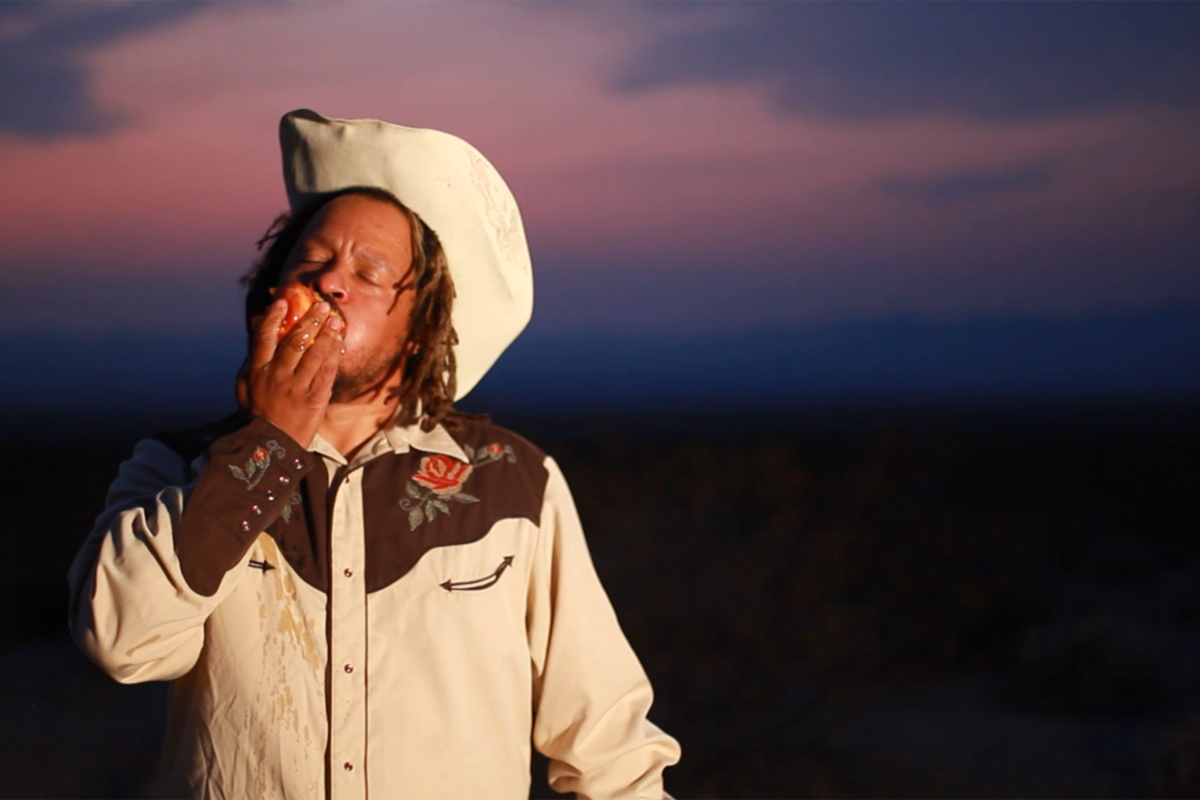
Brent Holmes offers another powerful example of how Deleuzian difference can be practiced in art. His exhibition Behold a Pale Horse at the Barrick Museum in Las Vegas engaged found objects, video, performance, and landscape to reclaim Black identity in the American West (Prevatt, 2021). Holmes uses desert environments, ranching histories, heirlooms, and mythologies to expose how dominant narratives erase Black and Indigenous presences. His work creates assemblages—land, history, body, object—that insist identity is not fixed but relational and multiple.
In Deleuzian terms, Holmes’ practice demonstrates becoming as refusal: a refusal to let dominant myths organise the field of identity. By folding Blackness into the contested spaces of desert and cowboy iconography, he fractures the narrative of whiteness as default.
Failure, risk, and crip practice
Lisa Le Feuvre argues that failure is not simply an obstacle but a vital dimension of creative life (2010). For artists in 2025, embracing failure is not only personal permission but political necessity. The fragmented, the unresolved, the uncomfortable often signal the refusal to assimilate.
Disabled and neurodivergent artists have long embodied this truth. Boué, for instance, builds neuro-inclusive practice that recognises altered rhythms, absence, and distortion as sources of creative method. This reframes dormancy as crip time (Kafer, 2013): not failure, but another tempo of survival and invention.

A troubling reminder
It is against this backdrop of difference and inclusion that the recent murder of Charlie Kirk unsettles the cultural field. Whatever one thinks of Kirk’s politics—markedly opposed to the values of queer, feminist, disabled, and racialised communities—his killing is abhorrent. Yet it also starkly illustrates the volatility of cultural struggle in the 21st century. Kirk was an influencer whose prominence rested on opposing precisely the demographics this essay seeks to platform. His death demonstrates that ideas and influence now carry consequences far beyond discourse.
From a Deleuzian perspective, the tragedy underscores the stakes of becoming in hostile times. When cultural and political battles are reduced to violent confrontation, the possibility of dialogue is foreclosed. For artists, the lesson is sharp: that the work of creating concepts and practices of difference must continue—not by replicating violence, but by refusing closure and insisting on multiplicity. Art becomes one of the few remaining spaces where the otherwise can still be imagined without annihilation.
Community and insurgency
Deleuze’s concept of assemblage offers a model for how artists can resist isolation. Assemblages are constellations of bodies, practices, and histories that cohere provisionally without erasing difference (Deleuze and Guattari, 1987). Queer, Black, feminist, disabled, and neurodivergent collectives are such assemblages. They demonstrate that identity is not solitary but relational, and that community can be insurgent rather than conformist.
Conclusion: no neutrality
To talk about creative block in 2025 without naming political forces is to misdiagnose the problem. Artists are not simply bored or burnt out. They are navigating a climate where difference itself is under siege.
Deleuze teaches that art is about creating concepts that allow life otherwise. In this climate, that means centring queer, Black, feminist, disabled, and neurodivergent practices—not as margins but as methodologies of becoming. The tragic violence that claimed Charlie Kirk is a sobering reminder of what is at stake: that culture and thought are never neutral, that difference is never safe.
Dormancy, then, is not failure but gestation—the pause before eruption. To continue making, thinking, and becoming otherwise is to confront authoritarian sameness with the unruly multiplicity of life.
References
Ahmed, S. (2012) On Being Included: Racism and Diversity in Institutional Life. Durham: Duke University Press.
Boué, S. (n.d.) Sonia Boué: Artist Website. Available at: https://www.soniaboue.co.uk/ (Accessed 12 September 2025).
Butler, J. (1990) Gender Trouble: Feminism and the Subversion of Identity. New York: Routledge.
Deleuze, G. and Guattari, F. (1987) A Thousand Plateaus: Capitalism and Schizophrenia. Minneapolis: University of Minnesota Press.
Deleuze, G. and Guattari, F. (1994) What is Philosophy? London: Verso.
Kafer, A. (2013) Feminist, Queer, Crip. Bloomington: Indiana University Press.
Le Feuvre, L. (2010) Failure. London: Whitechapel Gallery and MIT Press.
Muñoz, J.E. (2009) Cruising Utopia: The Then and There of Queer Futurity. New York: New York University Press.
Prevatt, M. (2021) ‘Brent Holmes’ Barrick Museum Exhibit Examines Black Identity and Western Roots’, Las Vegas Weekly, 4 February. Available at: https://lasvegasweekly.com/ae/fine-art/2021/feb/04/brent-holmes-barrick-examines-black-identity-west/ (Accessed 12 September 2025).

