AI image systems do not simply generate pictures; they reproduce and reshape power by learning from the gendered, racialised, and colonial biases already embedded in visual culture. This essay explores how feminist artists and theorists expose these structures and propose more ethical, relational, and community-driven ways of seeing and making with machines.
Artificial intelligence image systems are often presented as neutral tools that simply learn visual patterns from the world in order to produce new ones. Yet feminist theory has long argued that images are never neutral. They arise from power, history, labour, and the politics of who is seen, who is misrepresented, and who is missing. To understand AI image generation today, we must recognise it as a site where gendered and racialised histories of representation meet new economies of computation and data extraction.
Feminist scholars of technology remind us that every dataset has a worldview. AI models are built on scraped images from the internet, archives shaped by a history of patriarchal and colonial categorisation, and content filtered by global click workers whose identities and labour remain largely invisible. This means that AI systems often replicate narrow ideals of beauty, femininity, race, and sexuality, while making it difficult for non normative identities to appear with nuance or agency. In other words, AI learns from existing inequity and often repeats it at scale.
Artists working at the intersection of feminism and AI do not simply critique this dynamic. They also show us what new relations between technology and representation might look like. Stephanie Dinkins’ long term project Not the Only One is a powerful example. Rather than treating AI as a universal system, she trains a model on the oral histories of Black women in her own family. The work suggests that AI can hold community memory and relational knowledge when it is built from love, lineage, and care, instead of scale, surveillance, and profit.

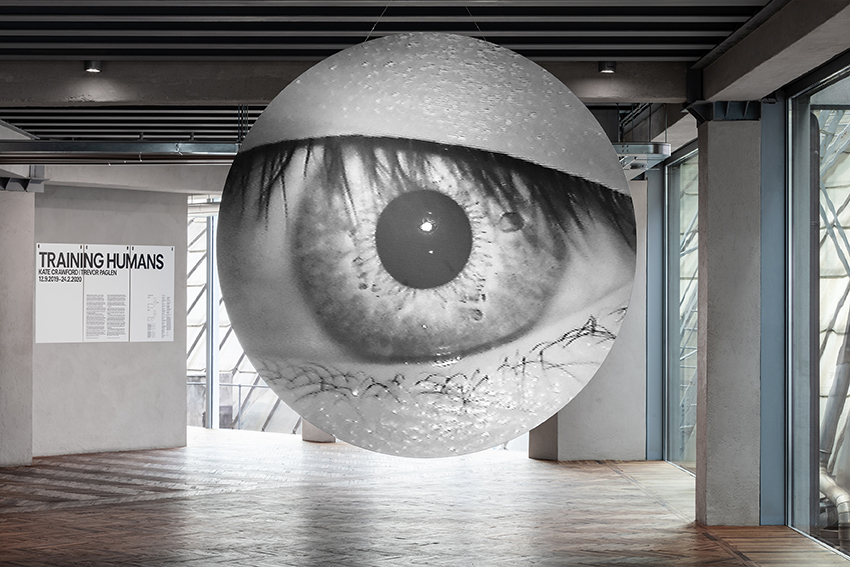
Kate Crawford and Trevor Paglen’s exhibition Training Humans pulls back the curtain even further. By displaying thousands of images used to train computer vision systems, they reveal the biases embedded within taxonomies of gender and race, and ask viewers to confront the uncomfortable truth that our bodies are repeatedly captured, categorised, and judged in ways we do not control. Their work illuminates the structural foundations of AI rather than its glamorous outputs.
Other artists focus on refusal and rupture. Legacy Russell’s concept of glitch feminism positions error and distortion as a space of resistance. In this context, artists who intentionally produce failed, disruptive, or uncanny AI images do not simply experiment with machine aesthetics. They break and bend the algorithm to create space for queer, unruly, and historically excluded identities to exist on their own terms. Morehshin Allahyari’s ongoing practice similarly inserts queer and feminist mythologies from West Asia into machine learning workflows, challenging the dominance of Western narratives in both technology and art history.
These practices share a belief that representation within AI is not only about inclusion. It is also about power, authorship, and the ethics of extraction. Holly Herndon and Mat Dryhurst’s project Holly+ approaches these questions through the politics of voice and consent. Rather than rejecting AI, they experiment with community governance and permission based creative sharing. Their work argues that people should decide how their likeness or voice circulates, and that collective creativity does not require dispossession.

Taken together, these artistic explorations reveal that AI image generation is not simply a technical evolution. It is a cultural and political one. As automation accelerates and images proliferate, questions once asked in feminist art and theory take on renewed urgency. Who has the right to be seen? Who decides which bodies are rendered desirable or deviant? What forms of life are considered worth remembering, and which are quietly erased by the logic of the dataset?
We are living in a moment of profound technological shift. Images are no longer only made by humans, but also by systems that reflect the values of the societies that build them. Feminist artists and thinkers remind us that technology is not destiny. It is shaped by power, and therefore open to critique, re imagination, and transformation. Their work invites us to imagine AI not as a force that replaces human creativity, but as a space where we can negotiate care, consent, collectivity, and more just futures.
In this light, AI becomes a cultural mirror. It shows us who we have been, and it challenges us to decide who we want to be. The question is not only how we teach machines to see, but also how we teach them to recognise the fullness of human life, especially where it has historically been overlooked. Feminist perspectives insist that the future of AI must centre equity, dignity, and relational imagination. They remind us that the politics of vision have always been inseparable from the politics of humanity itself.
References
Allahyari, M. (2021) She Who Sees the Unknown. Independent publication and ongoing series.
Benjamin, R. (2019) Race After Technology: Abolitionist Tools for the New Jim Code. Polity, Cambridge.
Broussard, M. (2018) Artificial Unintelligence: How Computers Misunderstand the World. MIT Press, Cambridge, MA.
Buolamwini, J. and Gebru, T. (2018) ‘Gender Shades: Intersectional Accuracy Disparities in Commercial Gender Classification’, Proceedings of Machine Learning Research, 81, pp. 1–15.
Crawford, K. (2021) Atlas of AI: Power, Politics, and the Planetary Costs of Artificial Intelligence. Yale University Press, New Haven.
Crawford, K. and Paglen, T. (2019) Training Humans. Fondazione Prada, Milan.
Dinkins, S. (2020) Not the Only One. Available at: https://www.stephaniedinkins.com
Haraway, D. (2016) Staying with the Trouble. Duke University Press, Durham.
Herndon, H. and Dryhurst, M. (2021–) Holly+. Spawning.
Lewis, S. (2022) Full Surrogacy Now: Feminism Against Family. Verso, London.
McCarthy, L. (2020) LAUREN. Available at: https://lauren-mccarthy.com
Mohamed, S., Png, M.T. and Isaac, W. (2020) ‘Decolonial AI: Decolonial Theory as Sociotechnical Foresight in Artificial Intelligence’, Philosophy & Technology, 33, pp. 659–684.
Noble, S.U. (2018) Algorithms of Oppression: How Search Engines Reinforce Racism. NYU Press, New York.
Onuoha, M. (2016–) The Library of Missing Datasets.
Russell, L. (2020) Glitch Feminism: A Manifesto. Verso, London.
Steyerl, H. (2013) ‘Too Much World: Is the Internet Dead?’ e-flux journal, 49.
Suchman, L. (2007) Human-Machine Reconfigurations: Plans and Situated Actions. 2nd ed. Cambridge University Press, Cambridge.
Wynter, S. (2003) ‘Unsettling the Coloniality of Being/Power/Truth/Freedom’, CR: The New Centennial Review, 3(3), pp. 257–337.
