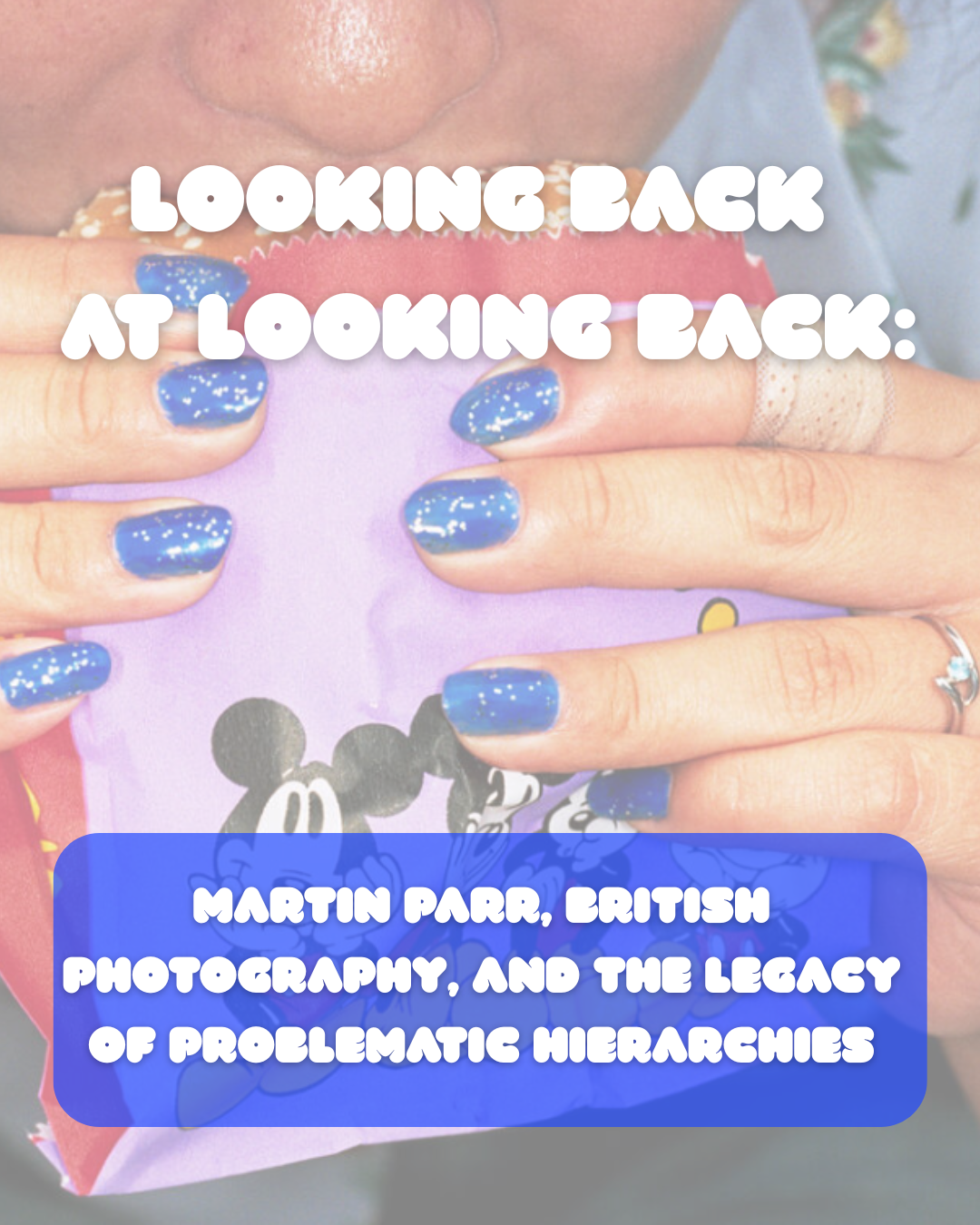
Martin Parr’s death invites a reckoning with a legacy that shaped a generation of British photographers while also revealing the ethical and representational fault lines embedded in late twentieth century documentary practice. This reflection holds admiration and critique together, acknowledging both the aesthetic force of his work and the problematic hierarchies and attitudes that shaped its production and reception.
The announcement of Martin Parr’s death last weekend invites both commemoration and critique, not as contradictory impulses but as the necessary duality through which any serious engagement with photographic history must pass. Parr’s work shaped generations of British photographers and was foundational to the visual literacy of students who entered the field in the early twenty first century. I was one of them. As a photography undergraduate at the University of Derby in the very early 2000s, I regarded Parr as a kind of secular patron saint of British social observation. Everything about his work struck me as electrifying. From satirising black and white images to saturated colours from his brazen ring flash, the theatrical index of British banality, the precision with which he immobilised his subjects within frames that were equal parts affectionate and merciless. It felt like the closest thing photography had to punk. Parr revealed Britain back to itself with the kitsch clarity of a carnival mirror. As a student, I adored it.

Yet the seduction of his style, and its potency within British photographic discourse, had consequences that only surfaced for me as I began to approach graduation. What had once felt like satire or democratic portrayal began to register as something more troubled. Parr’s oeuvre is frequently framed as a form of biting social observation, but the power dynamics within that observation became harder to ignore once I began to understand photography not only as an aesthetic practice but as a cultural and ethical act. The subjects in Parr’s images, so often working class, provincial, older, or socially marked by ordinariness, began to appear less like participants in a shared cultural critique and more like the objects of a gaze that presumed its own right to observe, classify, and display. The work had always possessed an air of superiority. Only later did I see how deeply that superiority was embedded in British photographic culture at large.

As an emerging academic, I encountered Parr publicly in an on-stage dialogue. In an exchange that became formative for me, I challenged him on the politics of representation and the ethics of looking. He did not expect such a provocation from an academic upstart and responded with a certainty that bordered on indifference to the changing discourses around agency, consent and the cultural violence of misrecognition. This confidence was not unusual among photographers of his generation. It was a confidence built on the extraordinary institutional celebration that upheld them and that often insulated them from meaningful critique. Parr was firmly a British megastar of photography by that point, a cultural figure whose authority functioned almost as a shield against the demands being made by younger scholars and practitioners, particularly women and marginalised people.

One moment in particular crystallised this for me. At a photography conference I overheard Parr and two prominent male photographers, Paul Hill, and the late Brian Griffin, describe a brilliant female photographer colleague of ours as “capable” but as a woman who “thinks she knows her own mind.” The remark was dismissive and casual, a gesture of patriarchal taxonomy that relied on diminishment for stability. I shan’t identify the woman in an effort to shield her from this sleight, but she stands in my mind as vastly more insightful, rigorous, and relevant to contemporary photographic culture than those who attempted to reduce her. That overheard exchange disrupted whatever residual veneration I held for these men. It marked the point at which I fully understood that photographic history, like most histories, is structured by hierarchies that determine who receives visibility, who is diminished and who has their place questioned even in rooms where they are the most intellectually luminous.
None of this negates the influence Parr and his contemporaries had on photographic language in the United Kingdom. Their contribution is undeniable. Parr changed how Britishness was seen and how the everyday was framed. His stylistic innovations, particularly his use of flash and colour, remain essential components in the visual vocabulary of contemporary photography. The legacy is real. It is also complicated.
The ethics of representation have evolved significantly since the early 2000s. Discourses shaped by thinkers such as Tina Campt, Ariella Azoulay, and Saidiya Hartman have recalibrated how we understand looking, power, consent and the burden that images can impose upon those who appear in them. British photography now operates within a cultural moment that is no longer satisfied with the notion of the photographer as a neutral or humorous observer. The shift in awareness surrounding class dynamics, cultural ownership and the history of social documentary has made it impossible to encounter Parr’s work without confronting its politics.

Parr, Hill, and Griffin were not aberrations. They were people shaped by their era, but they also worked in an environment that already possessed the theoretical tools to challenge the extractive tendencies of documentary practice. By the late twentieth century, feminist, postcolonial, and critical race scholars had already articulated the risks of objectification and misrepresentation. These photographers did not operate in an intellectual vacuum. They operated within an ecosystem that knew better but did not always do better. That is the unresolved tension in their legacy.

Grief for an influential figure can coexist with critique. To treat Parr’s work as beyond reproach would be to participate in the very mythology that once prevented me from seeing its flaws. To treat him only as a problematic figure would be to ignore the undeniable power and originality that shaped so many young practitioners, including myself. The truth rests in the overlap: British photography is indebted to Parr, yet British photography must also continue to examine the conditions that allowed certain voices to dominate while others were undermined, trivialised or pushed to the margins.
In the end, Parr’s death opens not just a space for remembrance but a space for reckoning. His work invites us to ask what documentary photography achieves, and at what cost. It asks us to confront the fragility of the photographer’s authority and to recognise that aesthetic brilliance does not absolve cultural harm. It asks us to consider how to look without claiming ownership of what we see.
The discourse is complex because photography is complex. It is a practice built on encounters that are never fully benign. To engage critically with Parr’s legacy is not to undo it but to deepen it, to allow space for a more honest understanding of British photographic history and the uneven terrain on which it was built. The task now is to hold admiration and critique together, not to resolve them, but to let them speak.
References
Azoulay, A. (2008). The Civil Contract of Photography. Zone Books.
Bate, D. (2016). Photography: The Key Concepts. Bloomsbury.
Campt, T. (2017). Listening to Images. Duke University Press.
Edwards, E. (2011). The Cultural Politics of Photography in the UK. In Photography: A Critical Introduction, edited by Liz Wells. Routledge.
Hall, S. (1997). Representation: Cultural Representations and Signifying Practices. Sage.
Hartman, S. (2008). Venus in Two Acts. Small Axe, 12(2), 1–14.
Parr, M. and Badger, G. (2004). The Photobook: A History, Volume I. Phaidon.
Sontag, S. (1977). On Photography. Penguin.
Tagg, J. (1988). The Burden of Representation: Essays on Photographies and Histories. Macmillan.
Wells, L. (ed.) (2021). Photography: A Critical Introduction. Fifth Edition. Routledge.
