A response to the question ‘Is art becoming too elitist?’

A recent Instagram post getting some traction asks, ‘is art becoming too elitist?’ Stating that, ‘when the only way into an artwork is through explanation, most people are excluded before they even begin.’ This was followed by an excerpt from an interview with Anna Ádám, the founder of the School of Disobedience, that ran over the next seven slides in the post talking about how important it is for artists to embrace their sensitivity and to work intuitively rather than fulfilling an ‘obedience to a language’ of intellect. Here is an excerpt from the post:
Do you think contemporary art has become too elitist — too intellectual, too coded, too disconnected from people?
Yes — but not because artists are elitist. The problem is subtler, quieter, and much more internal. What worries me today is not the complexity of art, but the way artists have been trained to fear their own sensitivity. The system has created a very particular kind of obedience: an obedience to sounding intelligent, conceptual, and institutionally fluent. An obedience to a language that very few people speak, including many artists themselves. Contemporary art has become a space where you must justify everything you feel. Where intuition must be translated into theory before it is allowed to appear. Where emotional intelligence is treated as a charming accessory, but not as a rigorous artistic source. (@school_of_disobedience, 2025)
While emotional intelligence is extremely important in creative practice, there is a messy conflation of intention, purpose, communication and literacy in these statements that I feel misses many of the marks it is aiming at. At the time I read this post, several responses from other artists agreed with the point that there is a systematic denial of sensitivity, emotion, and intuitive working in the making of art that is causing art to be elitist through the language used to explain it to its audiences. However, I noted two dissenting voices among the comments that suggested the problem was more complex than was being presented, which I agree with. I feel there are some important points in this discussion that deserve a closer look. My perspective is as a visual artist and I will be writing in these terms, but I feel the same principles apply to any creative discipline.
Creative methods
Ádám states that ‘what she longs for is sincerity, art that dares to stay close to the body, to intuition, to contradiction, to the emotional intelligence that everyone possesses but few are allowed to show. Art that is not afraid to be permeable, porous, relational. Art that doesn’t require you to pass through a wall [of] text before you can enter the experience.’ But what she doesn’t acknowledge in this statement is that this is the very basis for an explanation of an art that is made from intuition and comes from sensitivity to the body. In short, what Ádám states in her interview are the kinds of conceptual ideas needed to explain work made this way. Working intuitively is not some other way of working creatively. Working intuitively is a method like any creative method, and it deserves the words of explanation, like hers, to say so.
There is a division that runs through contemporary art history between artists who believe a viewer should be moved by an artwork to feel something from the encounter, and those who believe it is not possible to control the reaction that happens between art and viewer — that only the viewer can complete the work through the experience they bring to the moment of looking. These perspectives are not that far apart. The thing that separates them is where the artist places the responsibility for understanding the work. From one perspective, that responsibility is placed fully on the artwork to communicate, that is, from the artist’s communication through the work. For the other, the responsibility is on the viewer and the experiential knowledge they bring to the artwork. I believe both perspectives are valid and require an explanation as a gesture of good will towards the viewer. Should an artist be expected to explain the minutiae of their work? No. Should an artist give some context to help the viewer understand where they are coming from as an artist? Yes.
Creativity is a response
The urge to create is based in the desire to express something we have noticed. This is a sensory | intellectual function of our bodies — we experience and then try to understand what we experienced through expression of the experience. For most of us artists, we respond creatively when the experience has been a powerful one. I’m speaking in the simplest of terms here. However, what is implied in my simple description, but important to recognise is that we feel empowered to make a response. This agency is a freedom many of us take for granted as artists. Expressing our emotions, our opinions, and our perceptions from our unique perspective is an act of empowered creative privilege. Do we also have the right then to expect an audience to give their time to our expression? To understand what we are expressing without explanation? To be on the same wavelength as us in the expression? Many artists who commented on this post appear to feel they should be able to work intuitively and emotionally when making art without further input. Instead, they appear to feel it an imposition to be asked to explain their work.
Working intuitively as an artist is a wonderful experience, and I believe it is one of the things that is so compelling for audiences who appreciate an artist’s work. This intuitive response absolutely has a place in the creation of the work. It can be a motivating force that moves the development of the work. It may compel the artist forward and it may also be the thing that causes the artist to diverge in another direction. All of this process is interesting and deserves an explanation. None of the words used to explain such a process, if it is an authentic explanation, are empty, superficial, or elitist. These words are a significant part of the literacy involved in visual communication for both the artist to be able to articulate their motivations, and for an audience to understand.
To be visual is to speak
If we claim our expressive rights and believe that an audience is at least willing to engage with our creativity, why do we feel that our creativity should not need to be explained? To be visual is to communicate. Would we expect someone to understand what we said if we spoke different languages? Don’t we often have to explain what we have said and why we’ve said it? Communicating visually is no different. Granted, it is not easy to communicate through language what we felt compelled to communicate visually in the first place, but how can we expect anyone to engage with a visual expression without having some context for what we have found so inspiring as an artist, what themes are of interest to us, and how we approach our practice of making art? There is no art without context, so to think that the art can exist without giving some time to explaining the conditions it was made in, what was concerning us at the time of its making, and the influences that have impacted us and our work is naïve.
The post and many of the comments in agreement suggested that art education was smothering the free intuitive drive to create by requiring an intellectualisation of the work. That the art world was clothing art in flimsy, meaningless words, and that artists were being asked to justify their work in the same kind of language in order to gain acceptance. Again, visual literacy is the response to these complaints. All too often, it is true, there is a superfluous rambling of buzz words used to describe art from professionals, including artists, who should know better. Far from being elitist, this indicates an appalling lack of rigour in the art education of these individuals. Any artist, curator, art historian, critic, dealer, or collector worthy of their title has a deep knowledge of visual literacy and has developed the skills needed to explain a work of art in relation to the motivations of the artist. I immediately suspect the professional authenticity of anyone who explains a work of art in buzz words and empty catchphrases. I don’t think ‘elitist,’ I think ‘charlatan’ when I hear this language. It is very evident when someone has the skill to communicate in language what has been expressed visually. Therefore, being expected to explain one’s artwork or practice should not be seen as an elitist trap but is in fact a very real signal of visual literacy. Artists should not be afraid of this. It is an important professional skill that can only deepen respect of their work.
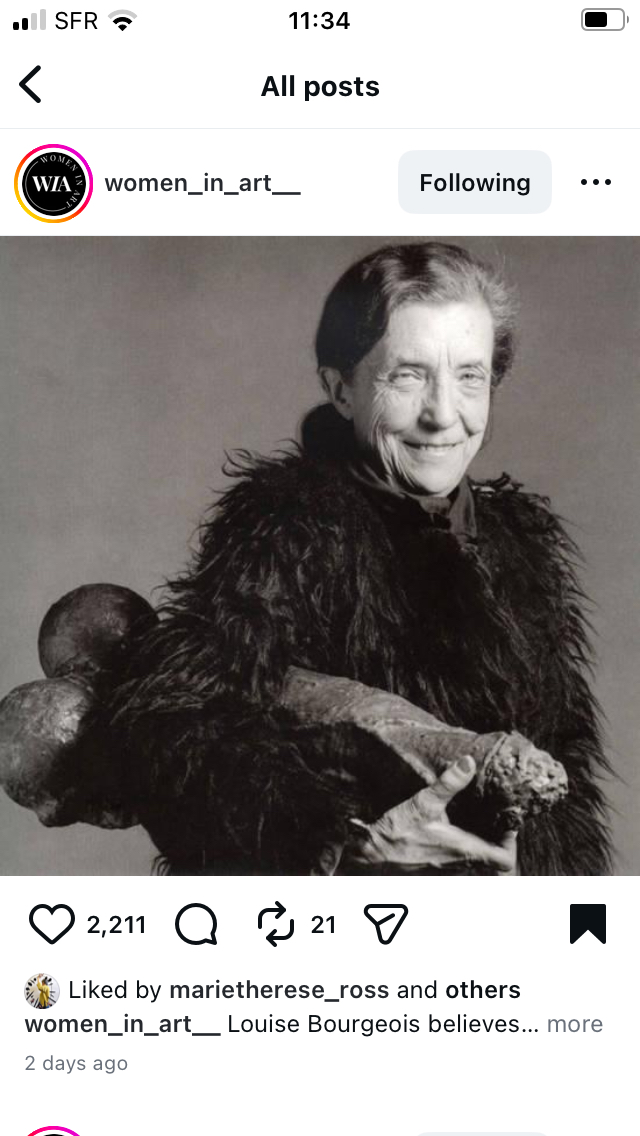
To illustrate this point, in one swift and astute response to @school_of_disobedience, demonstrating both support for these comments and criticism of them, as my own response does, @women_in_art__ reposted the @school_of_disobedience’s post, followed by a post of the infamous portrait of Louise Bourgeois holding her sculpture of a huge phallus taken by Robert Mapplethorpe with an overview of her beliefs ‘that art should first evoke emotions before it can be comprehended intellectually.’ This says two things, that these beliefs are shared by some of the most important artists who have ever created art, and that these artists have overcome obscurity to work in the highest echelons of the art world, communicating honestly and with integrity about their work. It also demonstrates the connection between emotions and intellect in art are not separated but entwined.
References
@school_of_disobedience, 2025. Is art becoming too elitist? [social media]. Instagram, 10 Dec. From an interview with Anna Ádám, Founder of the School of Disobedience, Budapest, Hungary.
@women_in_art__, 2025. Portrait of Louise Bourgeois © Robert Mapplethorpe Foundation [social media]. Instagram, 15 Dec.
Portrait of Louise Bourgeois © Robert Mapplethorpe Foundation.


