By [cloud] guest writer, Jim Bown
What happens when you point a phone at the background audience of a forty-year-old episode of Bullseye, add an overwrought power ballad, and put it on TikTok? Apparently: art criticism. This Critical Wednesday takes a gloriously peculiar dive into British nostalgia, spectatorship and voyvoyeurism, asking who exactly is watching whom, and whether sometimes we should stop dissecting the things we love and simply enjoy what we could’ve won.
Darts has (have) always played a significant part in my life. Both the game and the objects. Thursday night? Stick on the darts. Got a hot date? Let’s head down the Swan and have a game. Town a bit dead? Fuck it, we’ll play killer. With it now being the second biggest televised sport in the UK–due in part to the appearance of new talent like Luke Littler and Luke Humphreys–there’s been a real resurgence of love for the game over the last few years.
I myself was reared within a darts-watching environment. Curled up on the sofa, freshly filled with chippy tea, Sid Waddel’s geordie yells belting at me from the too-bright telly. Watching Van Barnevald and Phil “The Power” Taylor (hailing from a town barely a hop skip and jump from my own) vie for titles that made them higher than gentry to me. Two fat, balding, middle-aged men throwing spikes at a wall: the ultimate titans of my youth. As the teenage years rolled around, they brought with them a passion for the past, a nostalgia for a time in which I had never been. I spent untold hours trawling through youtube for old BDO footage. A more than skill-based admiration attracted me to the likes of Bobby George, John Lowe and–most of all–Eric Bristow. There was something about this unrivaled, loud-mouthed, cocksure cockney that put him a head above the rest. Days upon days spent at the pub with mates, convincing the bar staff that we were all 18, throwing arrow after arrow at the board. We had no end goal, no great dreams of going pro; I just loved feeling like a bitter-supping, rollie-smoking, trackie-wearing aristocrat when I stuck my pinky out before hitting a 141 finish.
This sudden second life for darts, spearheaded by a young star – it feels like that period again. At least to me, a man who never experienced it the first time around. But, while I can ramble about darts for another thirty thousand words, my mind is brought back to a bizarre by-product of that era. The lovechild of the 80’s lust for game shows, and the huge popularity of darts: Bullseye. And what a programme it was. Jim Bowen in his starched stiff suits, some random couplings from the middle of Arsehole, England, and an assortment of assorted quiz questions. A winning formula. I haven’t seen many episodes of the original show, nor do I feel the need to revisit them. Or I didn’t until recently.

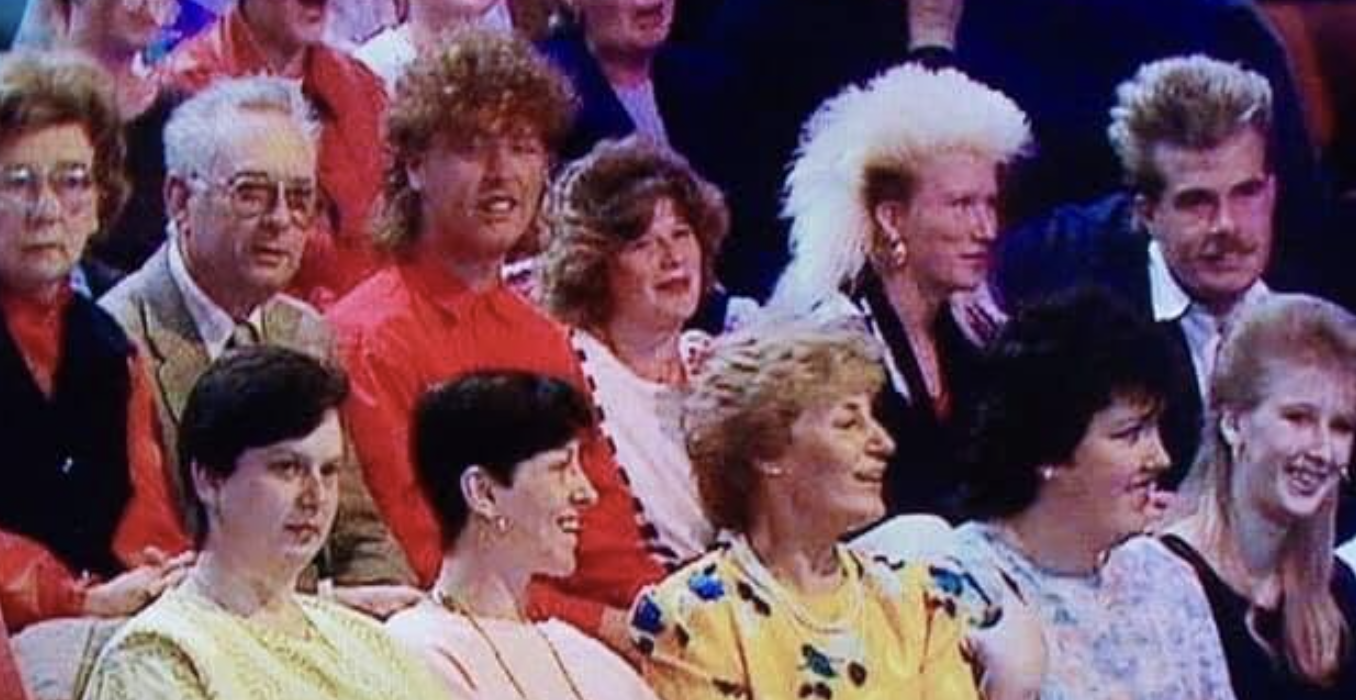
Like every other person living under the assumption of lifelong tenancy, I was scrolling through TikTok recently. I wasn’t paying much attention (why would I), until, through a crack, nestled betwixt the stone bricks of softcore porn and Rachel Reeves, I glimpsed a light of some mystical potential. From the artist BULLSEYE BACKGROUND PEOPLE (@bullseye.backgrou), an artwork that many would find predictable–if we were to judge on the name alone. Somehow, despite the obvious naming, each short film (which is what they are) strikes a very different chord with me. In this one: those first notes of “She’s Like the Wind” start playing as we slowly–tenderly–zoom past the rigid left arm of Jim Bowen, locked on to the smiling gaze of an elderly woman in the audience. It’s passionate, emotional. Swayze’s voice comes in as we settle in to a close-up of our assumed romantic lead:
“She’s like the wind through my tree
She rides through the night, next to me”
And still she smiles through the screen at us. A virtual, first-person love affair, transcending time and space. I can only assume she is my co-lead, my lover from a universe long since burned away.
But then we move– our eyes are moving! It’s as if we’ve been blown by Jim Bowen’s restrained hand movements across the crowd. We settle on a younger chap, bowl cut, pencil tache, blazer, shirt and maroon v-neck (he’d have loved matcha him). Perhaps this is our co-star.
“She leads me through moonlight”
Perhaps we shouldn’t take Swayze’s use of gender so literally in relation to what’s on screen– and we’re on the move again. A sharp dash. An elderly man. A young woman in red plaid and with the most incredible hair I’ve ever seen (as with many things, when it comes to hair, the bigger the better).
Where are we going? Who are we looking for? With this frantic movement I am convinced that we can only be looking for our lost love. The camera doesn’t stop moving, our eyes won’t stay put. It’s hard to tell which eye is moving when, the eye on the back of the phone or the eye stuck to the TV camera 40 years in the past.
A couple appears, marching on to the set. Are we a throuple? Progressive for the 80’s. It’s still on the edge of being transgressive now.
“Only to burn me with the sun”
It’s over. As with all tiktoks, it begins again. While I’m sat reeling over the emotions I’ve been put through, the quest for my estranged inamoratx begins anew.
I know it sounds daft, and exaggerated, laughable, and decidedly unserious. But there is something worth praising in the invention of a simple oddity that can prove to be so utterly engaging. The emotions you feel change from video to video: amusement at Pavarotti’s powerful aria Nessun Dorma; wistful nostalgia from party hats, party poppers, Jim Bowen, and Alphaville’s Forever Young; unabashed confusion at Gladys Knight playing as a young woman in her finest Maggie Thatcher cosplay takes that Midnight Train to Georgia. It’s a glimpse into a mundane section of the past. However, through it all, it is always intriguing. There’s something about watching the watcher that always is.
One thing worth noting is the music choices. On every single video a different song, most of which I have never heard used on TikTok before. But what they are, almost exclusively, are the kind of songs that are universally recognised. I know them, you know them, my granny knows them. Songs you’ll hear in the pub, at the football, on smooth radio, in those classic films that are a staple of winter weekends. Each video is soundtracked by a snippet of song plucked straight from our shared zeitgeist. Soul, rock, power ballad, synthpop, Robbie bastard Williams, the absolute drivel that is Richard Marx – it doesn’t matter, they’re all tunes we all know the second we hear them.
But, what do these choices mean when viewing the work? Do they have any effect at all? Well, yes. Else I wouldn’t have brought it up. For a start, it doesn’t half pull you in, hearing a song that’s so unassuming yet essential to how you view your own cultural identity. I have been using the word universal to describe the songs, perhaps incorrectly. However, in the small world that I have grown up in (i.e. Littleover Social Club, Derby. A.K.A. The Legion), and to some degree still live in today, they absolutely are. Secondly, they’re fucking funny. It’s incredibly hard not to giggle when you see an outrageously dressed 80’s newsagent staring blankly at you while Phil Collins’ Against All Odds plays overtop. But, on top of all this, and perhaps most importantly, it shows choice. A deliberate decision has been made by the artist to choose this specific snippet of this specific song for this specific video. Before the choice works or doesn’t work in the mind of the viewer, it gives them a reason to ask why: Why this song? Why this verse? Why not the chorus? Once you start asking questions about the piece, you start to strip back the layers and see more than just the funny TikTok video. For example, in one video Adele’s Hello is used to genuinely great effect. Just on the surface level it feels like our silent artist is calling to the past through the screen:
“Hello from the other side”
Those five words alone completely change the video from a comic glimpse at the not-so-far-flung past, to a heartfelt (while still comedic) lament for times gone by. It also led me to read the faces of the crowd differently. Those usual blank stares, with the guiding hand of the music, were transformed into solemn grimaces and wary glances at us through the screen. A distant departure indeed from the loving smiles seen behind Patrick Swayze’s Texan tonality. It is a genuine testament to the power that music has to generate emotion, and in conjunction with images, have a Rashomon-ic ability to change a narrative and a person’s perspective on it.
It’s not just the glimpse into the past that makes it interesting, nor is it the way in which the addition of music changes things. It’s that voyeur on voyeur action. Voyeurism². Voyvoyeurism. The fetishistic love of watching the watcher. It’s satisfying, sustaining, almost primal. I’ve never been an actor but it makes me wonder how many of them get into it just to watch the theatre audience gasp. Caroline Aherne twigged it in the 90’s with The Royle Family and people still make use of it today. We love to watch people engage and interact with media almost as much as (if not more than) we enjoy consuming said media ourselves. BULLSEYE BACKGROUND PEOPLE has – presumably accidentally – taken this idea in a whole new direction. Unlike things like Gogglebox or a YouTube reaction video, we’re not watching the watcher. We never see our voyeur of peoples past. Instead we (almost) look through their eyes. I mentioned before the eye in the back of the smartphone, our closest transplant for the eye of our voyeur, looking through the wormhole in the barrel of the TV lens.

Subconsciously, or indeed consciously, this changes how we view these works. We are used to watching people react, we do it all the time. During conversations, in film and TV, walking past people on the street. We’re used to it. It’s how we communicate, how we empathise, how we understand. But by placing us in the “eye” of the watcher, we suddenly become out of our element. We are almost walking in their shoes, seeing what they see. Almost. However, despite us being in the position empathy is described as, we have less at our disposal to judge the thoughts of our watcher. We have no expression or body language to read, no words to interpret, no exclamations, declarations or exhalations. No sounds or sights except those given to us by the voyeur. Our crutches have been pulled away; now we’re just being held up by the voyeur’s strings.
See, we aren’t actually looking through someone else’s eyes, and we’re definitely not hearing through their ears. Just as we are only hearing the songs that are chosen for us, we are only seeing that which is specifically shown to us. The way the phone camera moves from person to person implies predestination, as is usually the case of someone with a camera, they know where they want to point it. It only makes sense to assume that the voyeur is looking with their eyes first, and the camera – our eyes – second.
What we are watching is not an organic reaction. It is abstracted. Directed. Not only are we fish out of water, experiencing our voyeur without seeing or hearing them, just implicitly knowing they are present, we are at their mercy in a way. We are watching an orchestrated version of someone engaging with media. A director’s cut. It’s a kind of brechtian breaking of the fourth wall, our voyvoyeurism is being acknowledged and used to engage us with the videos even more.
Extracting all the layers lays bare an interesting scenario. We are an audience, watching an audience. However we are being directed on how we watch by another watcher of the same audience we are watching.

It fascinates me so completely how much we can garner from the artist we never even get to witness, just from how they show us the mutual target of our voyeuristic intentions. We are put in a position of special privilege, as while the artist is aware of an audience (as the video exists and has been uploaded to the internet), they know absolutely nothing about us. We are king creep, the ultimate peeping tom, voyeur supreme. We can read the artist. We can infer from the videos who they are, what their interests are. Watching these videos, we can read into the characters in the bullseye audience – of course we can – but it’s arguable we can read even more into the life, personality, and nature of our artist. Isn’t it exciting?
It makes my fucking fingers twitch, being able to find such rich and exciting ideas in something so trivial and everyday. It’s beautiful, but in a way anti-Romantic. To find something that invokes such a passion in you and then proceeding to dissect and devour it until you understand it so completely there isn’t any wonder left. It makes criticism difficult. It makes learning difficult. Converting it into a vicious, methodical, gruesome, predatory act. It almost disgusts me, watching myself sink my teeth into the still warm flesh of these things that brings me such a passionate joy. Ripping, tearing, and peeling through blood vessels, sinew, gristle to see the bones of my beautiful prey. Just to say that I understand it. I think I hate this.
At their least dissected, most surface level, these videos are brilliant. They tick all the boxes you’d want from a mindless TikTok scroll: engaging, nostalgic, lighthearted. They speak to a certain culture of people, who enjoy fun simple entertainment. They are a fun and exciting reworking of media from the past. But it also could quite easily, with just a little bit of deliberate engagement, act as a gateway into new things for people who, like me, would need to go out of their way to seek the arts and uncover a rich and interesting world that is held at an arms length. It takes the familiar (in both the imagery and the music) and remixes it, makes it new, makes itself a unique audience to engage with in a unique way.
It’s a simple concept, really, executed with minimal flare. Filming the background faces of an old 80’s game show. But it really spoke to me – definitely with the easy opening of nostalgia at first; like seeing a Punch & Judy show, listening to my dad swear he used to look like Tom Hanks while we watch Big, listening to my mum’s ABBA CD’s while I pilfer some beers and play darts in the garage, like playing football by the sewer tunnel with my cousins, or listening to Zoom by Fat Larry’s Band, it all hits where it needs to. It gave me a reason to stay a bit longer and immerse myself in a way we should do with all creative works, but don’t. By its nature it is something you want to watch more of, and spend time with, and peel back layer after layer to get to the core of how it charms you so easily and enraptures you so thoroughly. It turns itself into a beautiful example of so many different aspects of viewership and voyeurism (and voyvoyeurism). It’s a really quite unique, fun, and interesting tool for exploring the nature of an audience.
I’m not superstitious. Not properly. But when I spill salt I throw it over my left shoulder, I only cross my fingers on my left hand, and I keep all my lucky items in my phone case so they’re always with me. In there is a scratch card, only the one, because it’s the only one I’ve ever won owt on. I don’t remember how much I won, I can’t check because the front of the card has fused to a 2-for-1 voucher for a valentines funfair, but I think it was three quid (not that I ever actually cashed it in). This TikTok account feels like that, in its own way: just an innocuous little thing that I scratched the surface off of, and found myself a nice little three pound prize. Yet, somehow the scratch card is worth more to me than the cash would be. These videos feel similar. I know the value that’s under the surface, but I’m not convinced that it’s worth more to me than the excitement that surface itself provides.

[cloud]’s Guest Writer: Jim Bown
James, Jim, or “Him off the telly” Bown is an artist and writer based between Derby and London. His work is informed primarily by his limited attention span and lifelong inability to do what is expected of him. Graduating from the University of Derby in 2025, and the Royal College of Art in 2026, he is a creative who feels deeply infuriated by an ever-rising student debt and the fact that he can no longer call himself an outsider artist.
