A Visit to José Castro’s Miami Studio in Summer 2025
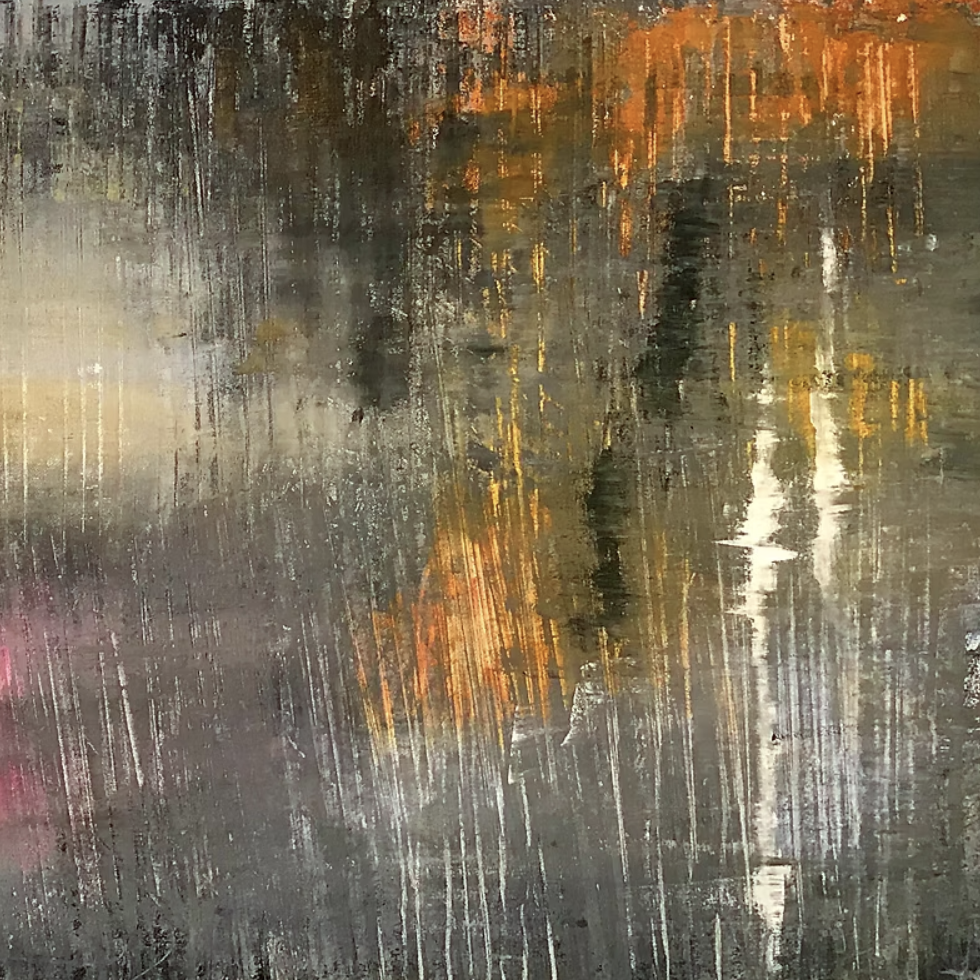
Walking into José Castro’s Miami studio in the summer of 2025 felt like entering a site of excavation rather than a space of display. Dust hovered in the air, rust crept across panels, and fabric sagged in quiet defiance of order. Here the studio was not a place of clean outcomes, but of open experiments where materials misbehave and chance is invited in. The works themselves were square in format, yet nothing within them seemed square at all. They strained at their own containment, holding together a dance of entropy and intention.
Castro’s practice calls to mind Deleuze’s notion of “the fold,” where surfaces are never static planes but continuous movements of concealment and revelation. Each plaster skin, each rust bloom, each stitched textile suggested a folding of time into material. The fold is not only formal, it is existential: memory itself curls in on itself, layering past and present into restless contact. The square format, so evocative of the modernist grid, becomes the frame that both contains and destabilizes these folds. A grid promises order, yet in Castro’s hands it becomes a stage for disorder to flourish.

Castro’s use of degraded photographs complicates this. His prints do not declare what has been, but rather what remains half-there, what flickers between disappearance and persistence.
His surfaces are never still. Rust is not treated as blemish but as eloquence, a writing of time across metal. Oxidation becomes text. Barthes once described the photograph as “that-has-been,” an index of the irretrievable. Castro’s use of degraded photographs complicates this. His prints do not declare what has been, but rather what remains half-there, what flickers between disappearance and persistence. They are less about evidencing the past than about staging its ghostly return. In some works, the photograph is buried beneath plaster, a trace glimpsed like handwriting through fog. This is not erasure but palimpsest, a Derridean layering where absence insists within presence.
The materials chosen are not innocent. For an artist shaped by Cuban exile, rust recalls both the industrial decay of Havana and the corrosion of enforced stasis under embargo. Fabric functions as a diasporic skin, patched and stitched with the logics of displacement. Photographic images recall not only people and places, but also the futility of attempting to preserve what is already changing. Here Glissant’s concept of opacity resonates strongly: the work refuses total legibility, holding its memories in folds and veils that cannot be fully deciphered. Opacity becomes a form of resistance against the smooth narratives of exile and assimilation.
There is a politics of surface at play. In Castro’s work, the surface is never simply exterior decoration. It is crust, scar, veil, mask. It is both protection and exposure. One could even say these surfaces echo Fanon’s meditations on the mask: a covering that both hides and reveals, one that negotiates between survival and visibility. The plastered-over photograph is never fully gone, it resists the comfort of closure. The mask is porous, leaking memory.

At the same time, there is wit embedded in this seriousness. Castro does not sanctify material decay. He allows it to play. A stain spreads like an impish accident. A tear opens like a grin across the otherwise solemn square. Entropy becomes not only metaphor but mischief. This prevents the work from collapsing into the heaviness of lament. Instead, it hovers, teasing between elegy and play, grief and curiosity.
The affect of these works lies in their refusal of perfection. Surfaces are cracked, smudged, and layered, but never forced into resolution. They breathe with flaws. They remind us that memory too is flawed, partial, always interrupted. To borrow from Kristeva, there is an abjection in these textures, a refusal to banish the messy remainder. Yet what might repel in another context becomes here the very substance of beauty.
The works map what could be called topographies of survival. They are not images in the conventional sense but landscapes of endurance. Their intelligence lies not only in their conceptual grounding but also in their capacity to seduce through surface, to invite touch through vision, to court entropy without despair.
Ultimately, Castro’s abstraction resists the idea that abstraction is evasive or detached. His practice demonstrates instead that abstraction can excavate, can entangle itself with history, with politics, with the lived textures of diaspora. The works map what could be called topographies of survival. They are not images in the conventional sense but landscapes of endurance. Their intelligence lies not only in their conceptual grounding but also in their capacity to seduce through surface, to invite touch through vision, to court entropy without despair.
To spend time with them is to see that matter is not mute. Matter speaks, whispers, and sometimes laughs. In Castro’s studio it behaves like a trickster philosopher, recording history while undoing it, staging absence while performing presence. The work is rigorous in its theoretical resonance and yet light in its invitation. It asks us to take memory seriously but never solemnly, to embrace its folds with curiosity, and perhaps even a grin.
Miami, with its layered diasporic histories and its role as a cultural threshold between the Caribbean and the Americas, offers a vital backdrop to this work. The city’s abstract practices often carry the weight of displacement, hybridity, and survival, and Castro’s studio sits firmly within that conversation. His abstraction does not float above history; it is tethered to the lived realities of exile and transformation that define Miami’s artistic identity. In this context, Castro’s practice feels both deeply personal and unmistakably of its place, a testament to the city’s ongoing negotiation between fracture and reinvention.
