A reappraisal of how contemporary Roma and Traveller women artists—Małgorzata Mirga-Tas, Delaine Le Bas, and Selma Selman—reclaim the image of the “female traveller” from stereotype to self-authored visibility through feminist, material, and philosophical re-framings of representation.
The term “Gypsy” is weighted by centuries of projection. In scholarship and in cultural policy the preferred terms are Roma, Sinti and Travellers, each with distinct histories and geographies. I keep the song-inflected title to register a shift: from the romanticised stranger of European folklore to contemporary self-representation by women who make work about mobility, kinship and survival on their own terms. This essay sketches how three artists—Małgorzata Mirga-Tas, Delaine Le Bas and Selma Selman—re-compose the figure of the female traveller in ways that refuse stereotype and open more generative imaginaries. A brief historical note on Ceija Stojka frames this present.
Re-patterning the canon: Małgorzata Mirga-Tas
In 2022 Małgorzata Mirga-Tas became the first Romani artist to represent a nation at the Venice Biennale with Re-enchanting the World, a cycle of monumental textile panels installed in the Polish Pavilion. Rather than reproduce the ethnographic gaze, Mirga-Tas splices fragments of domestic cloth donated by family and neighbours to stage Roma women as named, situated protagonists—hanging laundry, sharing talk, teaching skills. The series explicitly dialogues with the astrological frescoes of Palazzo Schifanoia and with Jacques Callot’s seventeenth-century Les Bohémiens, sources that long helped cement “the Gypsy” as decorative outsider. Mirga-Tas quotes those motifs and then reassigns value, stitching the lives of Roma women into art history as authors, not allegories.

Stuart Hall’s account of representation is useful here: meaning is made, not discovered, and images work as sites where power circulates. Mirga-Tas treats the pavilion as a discursive machine, making visible both the everyday labour of women and the structural conditions that have rendered them unseen. The old fabric is more than a material choice; it performs what Hall calls the “work of representation”, binding sign systems to lived histories so that spectators are implicated in how they look and what they recognise.
Witchcraft, borderwork and the unhomely: Delaine Le Bas
Delaine Le Bas, a British Romani artist, extends this feminist re-inscription through installations and performances that explore misrepresentation, displacement and the policing of mobility. Projects under the rubric Witch Hunt assemble textiles, painted signs, banners and makeshift architectures to stage a counter-archive of the Romani feminine: saint, mother, migrant, trickster. The witch, historically a figure through which patriarchal cultures disciplined unruly women, becomes Le Bas’s mobile sign for that disciplining and for resistance to it. The works read like temporary sanctuaries, erected wherever the show is staged, then dispersed again like travelling worlds.

If Homi Bhabha’s “third space” names a zone where cultural meanings are hybrid and negotiated, Le Bas builds that space in fabric and sound. Viewers move through thresholds that feel at once domestic and ceremonial. Borders are made tangible as curtains, strings, taped lines, then breached. The work insists that identity is not essence but relation, that the unhomely is not a deficit but a critical modality from which to read the nation.
Hard labour and the right to opacity: Selma Selman
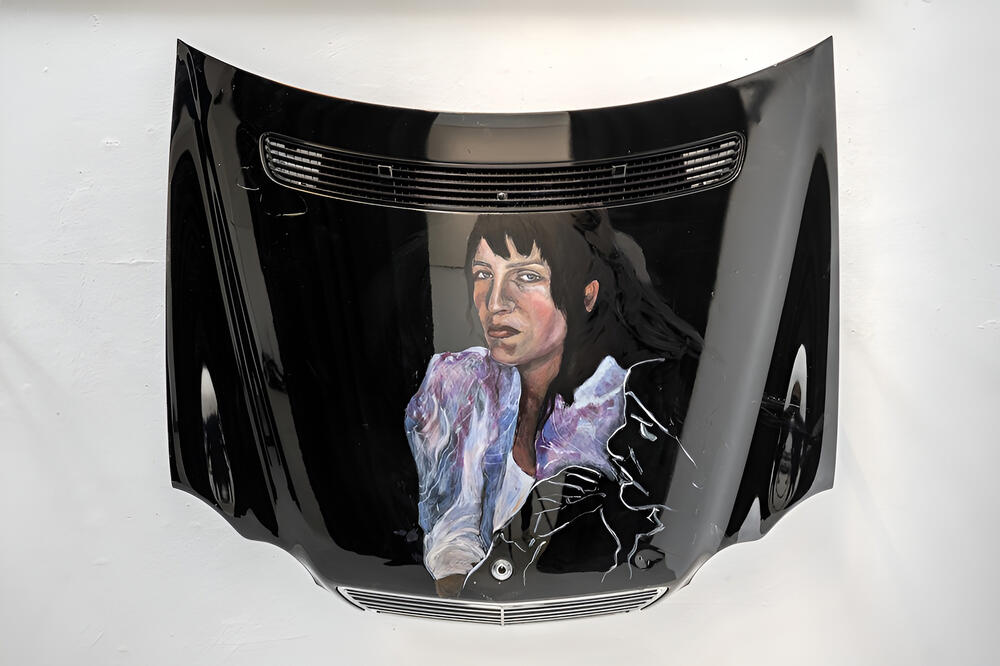
Bosnian Roma artist Selma Selman works in performance, video and social practice, often centring her mother, aunts and the economics of scrap metal, repair and resale. In Mercedes Matrix she and her family dismantle a car and redistribute its value, an action that exposes the art world’s own extractive desires while honouring the expertise of Roma women’s work. In You Have No Idea she repeats that phrase until it becomes a wall of sound, a refusal of legibility on demand and a pressure toward listening rather than decoding.

Bell hooks’s “oppositional gaze” helps parse Selman’s address. Rather than tender the intimate details that audiences may feel entitled to, Selman sets conditions for looking. The insistence that “you have no idea” is not coyness; it is a political pedagogy that asks viewers to feel the limits of their knowledge, then continue. Agency appears as the power to set the frame—to define which stories travel and on what terms.
A necessary prehistory: Ceija Stojka and memory as itinerary
The present gains contour against the testimony of Austrian Romani artist and writer Ceija Stojka, a survivor of Auschwitz, Ravensbrück and Bergen-Belsen. Her paintings and writings insist that Roma histories, including those of women, belong within Europe’s cultural memory, not at its edge. Stojka’s work is not illustrative sorrow; it moves from atrocity to scenes of community, seasons, markets, music, cooking. The itinerary matters—pain and continuity share a surface—so that later artists can claim visibility beyond the frame of trauma alone.
Rethinking the figure of the “female traveller”
Across these practices, the figure of the “female traveller” is no longer a romantic emblem of unbound freedom, nor an object in need of rescue, nor a cipher for exoticised difference. She appears instead as artist, mother, worker, neighbour and theorist of her own conditions. This reconstitution is not merely aesthetic but methodological—it alters how cultural narratives are made, who tells them, and under what circumstances they circulate.
In Mirga-Tas’s work, the act of naming performs a quiet revolution. By titling and situating her subjects, she restores identity where art history had favoured anonymity. The fortune-teller and the seductress, long-standing tropes of the itinerant woman, are replaced by individuals—mothers, daughters and friends—whose presence resists being folded back into stereotype. Authorship becomes a tool of reclamation: to be named is to exist within, rather than outside, the cultural archive.
Equally significant is the material ethics these artists enact. Their cloth, tents, car parts, signage and domestic gleanings are never props or picturesque devices; they are lived materials, saturated with use, debt and care. By reworking what is already at hand, they model what might be called a curatorial ethics of proximity—one grounded in exchange and accountability. Materials are borrowed from, and ultimately returned to, the communities from which they originate, turning the artwork into an extension of lived relations rather than an object of detached display.
For bell hooks, the politics of looking is inseparable from the politics of knowledge. These artists draw upon that principle, staging a form of situated spectatorship in which viewers are compelled to consider both how they look and from where. Each encounter becomes pedagogical: the work instructs through its address, unsettling the presumption of neutrality in viewing. The education it offers is affective and ethical rather than didactic.
Hybridity, in Homi Bhabha’s sense, provides another crucial frame. Too often misunderstood as a benign mixing of cultural forms, hybridity here designates a charged and contested zone where mobility meets bureaucracy, tradition meets experiment, and family meets institution. In the practices of Mirga-Tas, Le Bas and Selman, hybridity marks labour and negotiation rather than aesthetic fusion. It speaks to the ongoing work of living between systems that alternately exclude and appropriate, revealing how difference can be generative without being romanticised.
Finally, this rethinking of the female traveller extends beyond individual practice to the infrastructures that support representation itself. Organisations such as Pavee Point and the European Roma Institute for Arts and Culture (ERIAC) have shifted the cultural landscape by creating platforms where Roma and Traveller artists can define the terms of their own visibility. Exhibitions, archives and training programmes established under their auspices generate feedback loops between art and advocacy, ensuring that creative production operates not as tokenistic inclusion but as sustained participation. In this broader ecology, art becomes both document and agent of social renewal.
Critical stakes
Why stress these stakes now? Because representation has consequences. In the UK and across Europe, Roma and Traveller communities face housing precarity, surveillance of movement, intensified border regimes and hostile press cycles. When artists render everyday Roma and Traveller women as agents of history, they loosen the grip of those racialising narratives without romanticising hardship. When institutions platform that work with care, they rebalance the cultural record and model better ways of looking.
The title’s echo of Crystal Waters remains useful. The song’s hook is mobility through scarcity—she’s homeless, she’s got rhythm—an ambivalent 1990s pop parable. The artists discussed here push past that ambivalence. They re-make the image of the travelling woman as someone who determines the image itself. Their works choreograph relations between fabric and fresco, car part and museum wall, family story and national pavilion. In doing so they sketch a cultural horizon where “traveller” is not a fixed identity but a practice of survival, invention and belonging.
References
- Art Biennale Lab. “Re-enchanting the World.” Exhibition text for Małgorzata Mirga-Tas. Accessed 2025.
- ARTMargins Review. “Małgorzata Mirga-Tas: Re-enchanting the World, Polish Pavilion at the 2022 Venice Biennale.” 2023.
- e-flux. “Małgorzata Mirga-Tas: Re-enchanting the World.” 2022.
- The Guardian. Laura Cumming, “Małgorzata Mirga-Tas review – vivid, joyful stitchings from the Pole who shook Venice.” Oct 22, 2024.
- CCA Derry–Londonderry. “Delaine Le Bas, Witch Hunt.” Exhibition text. Accessed 2025.
- RomArchive. “Delaine Le Bas, Witch Hunt.” Collection entry. Accessed 2025.
- Blue Noun. “Goddesses & Persecution: Delaine Le Bas—Witch Hunt.” 2024.
- City of Women. “Selma Selman, Mercedes Matrix.” 2019.
- RomArchive. “Selma Selman, You Have No Idea.” Collection entry. Accessed 2025.
- Vimeo. “Selma Selman: You Have No Idea.” Performance documentation. 2016.
- Museo Reina Sofía. “Ceija Stojka.” Exhibition page and programme, 2019–2020.
- Wende Museum. “Ceija Stojka and Scenes of Roma Life.” Exhibition page. Accessed 2025.
- Hall, Stuart. Representation: Cultural Representations and Signifying Practices. London: Sage, 1997. See also Media Education Foundation transcript of Hall’s lecture.
- Bhabha, Homi K. The Location of Culture. London: Routledge, 1994. See also Maitland, “In-between a rock and a ‘third space’?” Translation Studies 9 no. 2 (2016) and Bhandari, “Homi K. Bhabha’s Third Space Theory and Cultural Identity,” 2022.
- hooks, bell. “The Oppositional Gaze: Black Female Spectators.” In Black Looks: Race and Representation (1992); reprinted in Feminist Film Theory: A Reader (1999).
- ERIAC — European Roma Institute for Arts and Culture. “Meet Your Neighbours: Contemporary Roma Art from Europe.” Ed. Timea Junghaus et al., pdf.
- Pavee Point Traveller and Roma Centre. “Arts and Culture Programme” and Traveller arts mapping resources. Accessed 2025.
- Dublin City Gallery The Hugh Lane and Pavee Point. Traveller Collection at the Hugh Lane Gallery (catalogue). 2020.
Note on terminology: Following the guidance of Traveller and Roma organisations and current scholarship, this essay uses Roma, Sinti and Travellers where possible and reserves “Gypsy” for historical reference and the work’s title.
