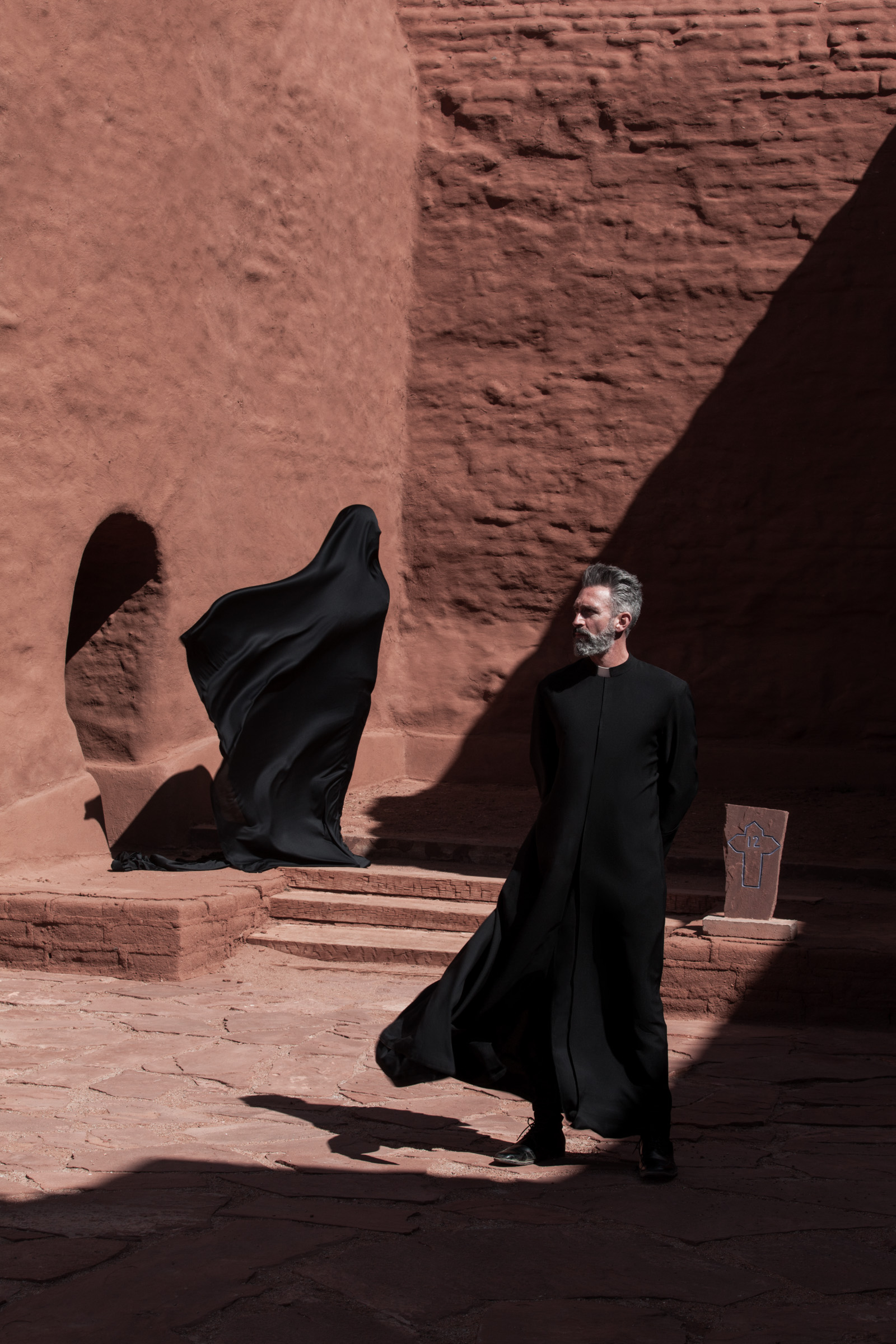
A Partner Through the Mist: Landscape and Domestic Environment in the Photography of Juan Sebastian
“In magical realist narratives something magical or supernatural occurs in an everyday setting and characters simply accept it as part of life rather than as something shocking.”[1]
Magical realism has seen most of its discourse within literary criticism, but it began as a term to describe German post-expressionist painters after WW1. It was first coined in 1925 by German photographer, art historian and critic, Franz Roh. His notion of magical realism ‘established the predominance of the subject, or inner self, over the object’ leading to a projection of ‘emotions and existential angst onto the objects…depicted [by expressionist artists], thereby deforming them.’[2] Magical realism began a slippery path of indistinct description and definition, until in contemporary Latin American literature it found more solid ground. For Latin American and Caribbean mid-twentieth century authors, magical realism was:
narrated from inside the protagonist’s mind in order to express, either a poetic view of the world and the self, or else a psychological and existential search for authenticity in a lurid world, viewed through the distorting prism of an alienated individual, who nevertheless succeeded in exposing disquieting existential truths.[3]

We see these vectors in Juan Sebastian’s photography. Claiming influence from magical realism authors, Gabriel Garcia-Marquez and Isabel Allende, it is easy to see the impact of their writing on his photography. The merging of the fantastic or magical within realistic and ordinary contexts is a hallmark of the artistic and literary genre, and it plays a role in Sebastian’s imagery where we see, ‘the commonplace becomes defamiliarised when seen from a naïve perspective, whereas the miraculous is rendered commonplace from the standpoint of the believer.’[4] This pairing of the naïve and the believer, is a thread that runs through Sebastian’s work in terms of how he positions the image for consideration. We are enticed to view the work with simplicity, or conversely with the deep understanding of the initiated. This bifurcated perspective allows us room to decide where we feel most at ease. However, it is this quotidian context, in the form of the landscape or domestic settings in Sebastian’s work that I will consider here, including in one instance where the landscape transcends the ordinary to become magical.
The environment, either the open landscape or the domestic setting plays three different roles in Sebastian’s photographs; it provides the space for the magical and the real to emerge and comingle; it constrains and controls causing tension and resistance; or it dominates and takes the lead role away from a shrouded indistinct entity where both become haunting.
In much of Sebastian’s Melodías en el Ocaso series, we slip between wide expanses of a Western terrain and the psychological world of the subjects in his imagery. The liminal space Sebastian allows us to enter through his photographs, between landscape and psychological state, is a gap formed not by space but by myth, lore, and fantasy. In such a liminal space the wide-open terrain only appears to provide space to breathe. Rather, it is a character in the magical representation of myth, cultural belief, and social conventions. The priest and the cowboy cannot exist without the landscape they traverse which carries them to encounter after encounter. It is a partner through a mist of mythical belief and folklore. The land is an intimate companion and keeper of secrets. It is the formation through which magic and realism conjoin.

We also see the psychological tension of constraint as Sebastian’s costumed subjects in Corazón Mulato emerge from or remain within domestic structures. The home or church binds Sebastian’s protagonists to their walls and thresholds. Fantasy is transferred directly from structure to subject with no gulf between them. Domestic sanctuary and individual form each other, and within each other they reside. These domestic environments are a character too in Sebastian’s photographs. They are neurotic and needy, suspicious and jealous always grasping and craving control. Like the imaginary town of Macondo in Garcia-Marquez’s writing, these domestic places forget their history and constantly seek it out by binding individuals to them. The subjects in these settings act out these influences through magical costume as they struggle against the formidable presence that makes them. Donning disguise that both conceals and transforms their persona, they express the internal fantasy of escape and confinement, merging the myth of freedom with the shackle of history. It is possible to read these psychological dramas playing out in Sebastian’s imagery because the landscape and domestic environment are activated characters in the work. The surroundings bring a tale of existence and experience, just as the subjects do.

However, the landscape emerges as the dominant character in Sebastian’s Con Las Voces De Otros Eternos series where an anonymous and mysterious shrouded figure is present in the landscape but not formed by it. Figure and surroundings resist merging and tussle for dominance. These images present a disruption of character identity, but in these images, identity is not an expression of selfhood, it is a force of will. There is struggle between conflicting mysteries. Land and figure haunt each other, and in turn, they haunt us. In such a haunting, anything is possible and we feel the challenge to our own selfhood in images such as these.
Of course, rational viewers may not apprehend these readings between the environment and the subject of Sebastian’s photography, but that is the point of magical realism, in order to reconcile the incongruous perspectives of the fantastical and the real, it is necessary to suspend disbelief and let the narrator, in this case, Sebastian, steer the course. Anyone willing to suspend disbelief will be able to see the relationships between surroundings and figure as Sebastian composes them through the camera lens. They will be able to see the fantastical in the real, and the realism in the fantasy. They will be able to see the psychological emanations and the anthropomorphism of the surroundings. But to not see these things is no failing. It just highlights what a magical thing it is to combine fantasy with reality.
[1] López-Calvo, I. ed., 2014. About this volume. Critical insights: magic realism. Ipswich, MA: Salem Press/Grey House Publishing, pp. ix-xv. Quote on page xi describes the difference between magical realism and the fantastic as put forth by Gene H. Bell-Villada’s essay in the volume. For my purposes in this essay, my focus is on magical realism. The full quote for those who are interested is: “As he [Bell-Villada] explains, whereas in magical realist narratives something magical or supernatural occurs in an everyday setting and characters simply accept it as part of life rather than as something shocking, in the fantastic, unreal events inevitably elicit hesitation in the reader, who cannot decide whether the supernatural events are ‘really happening’ or are somehow illusory.”
[2] Camayd-Freixas, 2014. Theories of magical realism. In: López-Calvo, I., ed., Critical insights: magic realism. Ipswich, MA: Salem Press/Grey House Publishing, pp. 3-15. Quote on page 4.
[3] Ibid, p.5.
[4] Ibid, p.10.
